

找到
227
篇与
科普知识
相关的结果
-
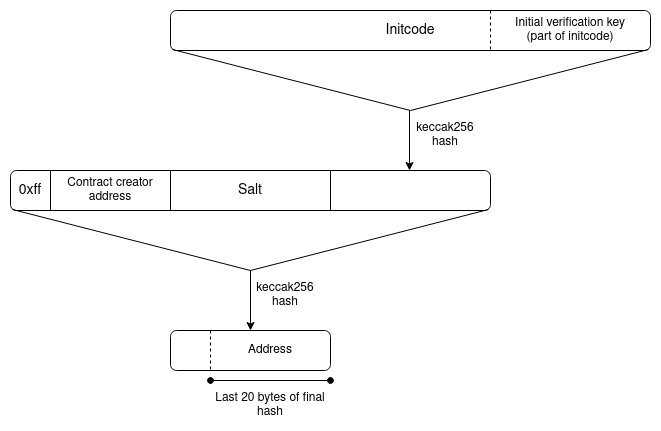
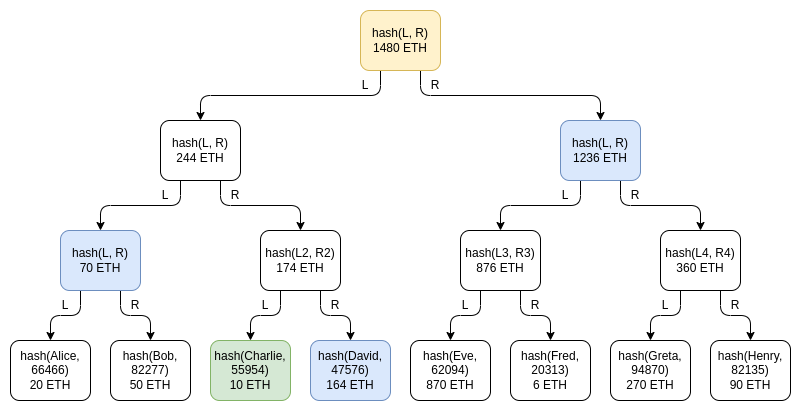
 Deeper dive on cross-L2 reading for wallets and other use cases Deeper dive on cross-L2 reading for wallets and other use cases2023 Jun 20 See all posts Deeper dive on cross-L2 reading for wallets and other use cases Special thanks to Yoav Weiss, Dan Finlay, Martin Koppelmann, and the Arbitrum, Optimism, Polygon, Scroll and SoulWallet teams for feedback and review.In this post on the Three Transitions, I outlined some key reasons why it's valuable to start thinking explicitly about L1 + cross-L2 support, wallet security, and privacy as necessary basic features of the ecosystem stack, rather than building each of these things as addons that can be designed separately by individual wallets.This post will focus more directly on the technical aspects of one specific sub-problem: how to make it easier to read L1 from L2, L2 from L1, or an L2 from another L2. Solving this problem is crucial for implementing an asset / keystore separation architecture, but it also has valuable use cases in other areas, most notably optimizing reliable cross-L2 calls, including use cases like moving assets between L1 and L2s.Recommended pre-readsPost on the Three Transitions Ideas from the Safe team on holding assets across multiple chains Why we need wide adoption of social recovery wallets ZK-SNARKs, and some privacy applications Dankrad on KZG commitments Verkle trees Table of contentsWhat is the goal? What does a cross-chain proof look like? What kinds of proof schemes can we use? Merkle proofs ZK SNARKs Special purpose KZG proofs Verkle tree proofs Aggregation Direct state reading How does L2 learn the recent Ethereum state root? Wallets on chains that are not L2s Preserving privacy Summary What is the goal?Once L2s become more mainstream, users will have assets across multiple L2s, and possibly L1 as well. Once smart contract wallets (multisig, social recovery or otherwise) become mainstream, the keys needed to access some account are going to change over time, and old keys would need to no longer be valid. Once both of these things happen, a user will need to have a way to change the keys that have authority to access many accounts which live in many different places, without making an extremely high number of transactions.Particularly, we need a way to handle counterfactual addresses: addresses that have not yet been "registered" in any way on-chain, but which nevertheless need to receive and securely hold funds. We all depend on counterfactual addresses: when you use Ethereum for the first time, you are able to generate an ETH address that someone can use to pay you, without "registering" the address on-chain (which would require paying txfees, and hence already holding some ETH).With EOAs, all addresses start off as counterfactual addresses. With smart contract wallets, counterfactual addresses are still possible, largely thanks to CREATE2, which allows you to have an ETH address that can only be filled by a smart contract that has code matching a particular hash. EIP-1014 (CREATE2) address calculation algorithm. However, smart contract wallets introduce a new challenge: the possibility of access keys changing. The address, which is a hash of the initcode, can only contain the wallet's initial verification key. The current verification key would be stored in the wallet's storage, but that storage record does not magically propagate to other L2s.If a user has many addresses on many L2s, including addresses that (because they are counterfactual) the L2 that they are on does not know about, then it seems like there is only one way to allow users to change their keys: asset / keystore separation architecture. Each user has (i) a "keystore contract" (on L1 or on one particular L2), which stores the verification key for all wallets along with the rules for changing the key, and (ii) "wallet contracts" on L1 and many L2s, which read cross-chain to get the verification key. There are two ways to implement this:Light version (check only to update keys): each wallet stores the verification key locally, and contains a function which can be called to check a cross-chain proof of the keystore's current state, and update its locally stored verification key to match. When a wallet is used for the first time on a particular L2, calling that function to obtain the current verification key from the keystore is mandatory. Upside: uses cross-chain proofs sparingly, so it's okay if cross-chain proofs are expensive. All funds are only spendable with the current keys, so it's still secure. Downside: To change the verification key, you have to make an on-chain key change in both the keystore and in every wallet that is already initialized (though not counterfactual ones). This could cost a lot of gas. Heavy version (check for every tx): a cross-chain proof showing the key currently in the keystore is necessary for each transaction. Upside: less systemic complexity, and keystore updating is cheap. Downside: expensive per-tx, so requires much more engineering to make cross-chain proofs acceptably cheap. Also not easily compatible with ERC-4337, which currently does not support cross-contract reading of mutable objects during validation. What does a cross-chain proof look like?To show the full complexity, we'll explore the most difficult case: where the keystore is on one L2, and the wallet is on a different L2. If either the keystore or the wallet is on L1, then only half of this design is needed. Let's assume that the keystore is on Linea, and the wallet is on Kakarot. A full proof of the keys to the wallet consists of:A proof proving the current Linea state root, given the current Ethereum state root that Kakarot knows about A proof proving the current keys in the keystore, given the current Linea state root There are two primary tricky implementation questions here:What kind of proof do we use? (Is it Merkle proofs? something else?) How does the L2 learn the recent L1 (Ethereum) state root (or, as we shall see, potentially the full L1 state) in the first place? And alternatively, how does the L1 learn the L2 state root? In both cases, how long are the delays between something happening on one side, and that thing being provable to the other side? What kinds of proof schemes can we use?There are five major options:Merkle proofs General-purpose ZK-SNARKs Special-purpose proofs (eg. with KZG) Verkle proofs, which are somewhere between KZG and ZK-SNARKs on both infrastructure workload and cost. No proofs and rely on direct state reading In terms of infrastructure work required and cost for users, I rank them roughly as follows: "Aggregation" refers to the idea of aggregating all the proofs supplied by users within each block into a big meta-proof that combines all of them. This is possible for SNARKs, and for KZG, but not for Merkle branches (you can combine Merkle branches a little bit, but it only saves you log(txs per block) / log(total number of keystores), perhaps 15-30% in practice, so it's probably not worth the cost).Aggregation only becomes worth it once the scheme has a substantial number of users, so realistically it's okay for a version-1 implementation to leave aggregation out, and implement that for version 2.How would Merkle proofs work?This one is simple: follow the diagram in the previous section directly. More precisely, each "proof" (assuming the max-difficulty case of proving one L2 into another L2) would contain:A Merkle branch proving the state-root of the keystore-holding L2, given the most recent state root of Ethereum that the L2 knows about. The keystore-holding L2's state root is stored at a known storage slot of a known address (the contract on L1 representing the L2), and so the path through the tree could be hardcoded. A Merkle branch proving the current verification keys, given the state-root of the keystore-holding L2. Here once again, the verification key is stored at a known storage slot of a known address, so the path can be hardcoded. Unfortunately, Ethereum state proofs are complicated, but there exist libraries for verifying them, and if you use these libraries, this mechanism is not too complicated to implement.The larger problem is cost. Merkle proofs are long, and Patricia trees are unfortunately ~3.9x longer than necessary (precisely: an ideal Merkle proof into a tree holding N objects is 32 * log2(N) bytes long, and because Ethereum's Patricia trees have 16 leaves per child, proofs for those trees are 32 * 15 * log16(N) ~= 125 * log2(N) bytes long). In a state with roughly 250 million (~2²⁸) accounts, this makes each proof 125 * 28 = 3500 bytes, or about 56,000 gas, plus extra costs for decoding and verifying hashes.Two proofs together would end up costing around 100,000 to 150,000 gas (not including signature verification if this is used per-transaction) - significantly more than the current base 21,000 gas per transaction. But the disparity gets worse if the proof is being verified on L2. Computation inside an L2 is cheap, because computation is done off-chain and in an ecosystem with much fewer nodes than L1. Data, on the other hand, has to be posted to L1. Hence, the comparison is not 21000 gas vs 150,000 gas; it's 21,000 L2 gas vs 100,000 L1 gas.We can calculate what this means by looking at comparisons between L1 gas costs and L2 gas costs: L1 is currently about 15-25x more expensive than L2 for simple sends, and 20-50x more expensive for token swaps. Simple sends are relatively data-heavy, but swaps are much more computationally heavy. Hence, swaps are a better benchmark to approximate cost of L1 computation vs L2 computation. Taking all this into account, if we assume a 30x cost ratio between L1 computation cost and L2 computation cost, this seems to imply that putting a Merkle proof on L2 will cost the equivalent of perhaps fifty regular transactions.Of course, using a binary Merkle tree can cut costs by ~4x, but even still, the cost is in most cases going to be too high - and if we're willing to make the sacrifice of no longer being compatible with Ethereum's current hexary state tree, we might as well seek even better options.How would ZK-SNARK proofs work?Conceptually, the use of ZK-SNARKs is also easy to understand: you simply replace the Merkle proofs in the diagram above with a ZK-SNARK proving that those Merkle proofs exist. A ZK-SNARK costs ~400,000 gas of computation, and about 400 bytes (compare: 21,000 gas and 100 bytes for a basic transaction, in the future reducible to ~25 bytes with compression). Hence, from a computational perspective, a ZK-SNARK costs 19x the cost of a basic transaction today, and from a data perspective, a ZK-SNARK costs 4x as much as a basic transaction today, and 16x what a basic transaction may cost in the future.These numbers are a massive improvement over Merkle proofs, but they are still quite expensive. There are two ways to improve on this: (i) special-purpose KZG proofs, or (ii) aggregation, similar to ERC-4337 aggregation but using more fancy math. We can look into both.How would special-purpose KZG proofs work?Warning, this section is much more mathy than other sections. This is because we're going beyond general-purpose tools and building something special-purpose to be cheaper, so we have to go "under the hood" a lot more. If you don't like deep math, skip straight to the next section.First, a recap of how KZG commitments work:We can represent a set of data [D_1 ... D_n] with a KZG proof of a polynomial derived from the data: specifically, the polynomial P where P(w) = D_1, P(w²) = D_2 ... P(wⁿ) = D_n. w here is a "root of unity", a value where wᴺ = 1 for some evaluation domain size N (this is all done in a finite field). To "commit" to P, we create an elliptic curve point com(P) = P₀ * G + P₁ * S₁ + ... + Pₖ * Sₖ. Here: G is the generator point of the curve Pᵢ is the i'th-degree coefficient of the polynomial P Sᵢ is the i'th point in the trusted setup To prove P(z) = a, we create a quotient polynomial Q = (P - a) / (X - z), and create a commitment com(Q) to it. It is only possible to create such a polynomial if P(z) actually equals a. To verify a proof, we check the equation Q * (X - z) = P - a by doing an elliptic curve check on the proof com(Q) and the polynomial commitment com(P): we check e(com(Q), com(X - z)) ?= e(com(P) - com(a), com(1)) Some key properties that are important to understand are:A proof is just the com(Q) value, which is 48 bytes com(P₁) + com(P₂) = com(P₁ + P₂) This also means that you can "edit" a value into an existing a commitment. Suppose that we know that D_i is currently a, we want to set it to b, and the existing commitment to D is com(P). A commitment to "P, but with P(wⁱ) = b, and no other evaluations changed", then we set com(new_P) = com(P) + (b-a) * com(Lᵢ), where Lᵢ is a the "Lagrange polynomial" that equals 1 at wⁱ and 0 at other wʲ points. To perform these updates efficiently, all N commitments to Lagrange polynomials (com(Lᵢ)) can be pre-calculated and stored by each client. Inside a contract on-chain it may be too much to store all N commitments, so instead you could make a KZG commitment to the set of com(L_i) (or hash(com(L_i)) values, so whenever someone needs to update the tree on-chain they can simply provide the appropriate com(L_i) with a proof of its correctness. Hence, we have a structure where we can just keep adding values to the end of an ever-growing list, though with a certain size limit (realistically, hundreds of millions could be viable). We then use that as our data structure to manage (i) a commitment to the list of keys on each L2, stored on that L2 and mirrored to L1, and (ii) a commitment to the list of L2 key-commitments, stored on the Ethereum L1 and mirrored to each L2.Keeping the commitments updated could either become part of core L2 logic, or it could be implemented without L2 core-protocol changes through deposit and withdraw bridges. A full proof would thus require:The latest com(key list) on the keystore-holding L2 (48 bytes) KZG proof of com(key list) being a value inside com(mirror_list), the commitment to the list of all key list comitments (48 bytes) KZG proof of your key in com(key list) (48 bytes, plus 4 bytes for the index) It's actually possible to merge the two KZG proofs into one, so we get a total size of only 100 bytes.Note one subtlety: because the key list is a list, and not a key/value map like the state is, the key list will have to assign positions sequentially. The key commitment contract would contain its own internal registry mapping each keystore to an ID, and for each key it would store hash(key, address of the keystore) instead of just key, to unambiguously communicate to other L2s which keystore a particular entry is talking about.The upside of this technique is that it performs very well on L2. The data is 100 bytes, ~4x shorter than a ZK-SNARK and waaaay shorter than a Merkle proof. The computation cost is largely one size-2 pairing check, or about 119,000 gas. On L1, data is less important than computation, and so unfortunately KZG is somewhat more expensive than Merkle proofs.How would Verkle trees work?Verkle trees essentially involve stacking KZG commitments (or IPA commitments, which can be more efficient and use simpler cryptography) on top of each other: to store 2⁴⁸ values, you can make a KZG commitment to a list of 2²⁴ values, each of which itself is a KZG commitment to 2²⁴ values. Verkle trees are being strongly considered for the Ethereum state tree, because Verkle trees can be used to hold key-value maps and not just lists (basically, you can make a size-2²⁵⁶ tree but start it empty, only filling in specific parts of the tree once you actually need to fill them). What a Verkle tree looks like. In practice, you might give each node a width of 256 == 2⁸ for IPA-based trees, or 2²⁴ for KZG-based trees. Proofs in Verkle trees are somewhat longer than KZG; they might be a few hundred bytes long. They are also difficult to verify, especially if you try to aggregate many proofs into one.Realistically, Verkle trees should be considered to be like Merkle trees, but more viable without SNARKing (because of the lower data costs), and cheaper with SNARKing (because of lower prover costs).The largest advantage of Verkle trees is the possibility of harmonizing data structures: Verkle proofs could be used directly over L1 or L2 state, without overlay structures, and using the exact same mechanism for L1 and L2. Once quantum computers become an issue, or once proving Merkle branches becomes efficient enough, Verkle trees could be replaced in-place with a binary hash tree with a suitable SNARK-friendly hash function.AggregationIf N users make N transactions (or more realistically, N ERC-4337 UserOperations) that need to prove N cross-chain claims, we can save a lot of gas by aggregating those proofs: the builder that would be combining those transactions into a block or bundle that goes into a block can create a single proof that proves all of those claims simultaneously.This could mean:A ZK-SNARK proof of N Merkle branches A KZG multi-proof A Verkle multi-proof (or a ZK-SNARK of a multi-proof) In all three cases, the proofs would only cost a few hundred thousand gas each. The builder would need to make one of these on each L2 for the users in that L2; hence, for this to be useful to build, the scheme as a whole needs to have enough usage that there are very often at least a few transactions within the same block on multiple major L2s.If ZK-SNARKs are used, the main marginal cost is simply "business logic" of passing numbers around between contracts, so perhaps a few thousand L2 gas per user. If KZG multi-proofs are used, the prover would need to add 48 gas for each keystore-holding L2 that is used within that block, so the marginal cost of the scheme per user would add another ~800 L1 gas per L2 (not per user) on top. But these costs are much lower than the costs of not aggregating, which inevitably involve over 10,000 L1 gas and hundreds of thousands of L2 gas per user. For Verkle trees, you can either use Verkle multi-proofs directly, adding around 100-200 bytes per user, or you can make a ZK-SNARK of a Verkle multi-proof, which has similar costs to ZK-SNARKs of Merkle branches but is significantly cheaper to prove.From an implementation perspective, it's probably best to have bundlers aggregate cross-chain proofs through the ERC-4337 account abstraction standard. ERC-4337 already has a mechanism for builders to aggregate parts of UserOperations in custom ways. There is even an implementation of this for BLS signature aggregation, which could reduce gas costs on L2 by 1.5x to 3x depending on what other forms of compression are included. Diagram from a BLS wallet implementation post showing the workflow of BLS aggregate signatures within an earlier version of ERC-4337. The workflow of aggregating cross-chain proofs will likely look very similar.Direct state readingA final possibility, and one only usable for L2 reading L1 (and not L1 reading L2), is to modify L2s to let them make static calls to contracts on L1 directly.This could be done with an opcode or a precompile, which allows calls into L1 where you provide the destination address, gas and calldata, and it returns the output, though because these calls are static-calls they cannot actually change any L1 state. L2s have to be aware of L1 already to process deposits, so there is nothing fundamental stopping such a thing from being implemented; it is mainly a technical implementation challenge (see: this RFP from Optimism to support static calls into L1).Notice that if the keystore is on L1, and L2s integrate L1 static-call functionality, then no proofs are required at all! However, if L2s don't integrate L1 static-calls, or if the keystore is on L2 (which it may eventually have to be, once L1 gets too expensive for users to use even a little bit), then proofs will be required.How does L2 learn the recent Ethereum state root?All of the schemes above require the L2 to access either the recent L1 state root, or the entire recent L1 state. Fortunately, all L2s have some functionality to access the recent L1 state already. This is because they need such a functionality to process messages coming in from L1 to the L2, most notably deposits.And indeed, if an L2 has a deposit feature, then you can use that L2 as-is to move L1 state roots into a contract on the L2: simply have a contract on L1 call the BLOCKHASH opcode, and pass it to L2 as a deposit message. The full block header can be received, and its state root extracted, on the L2 side. However, it would be much better for every L2 to have an explicit way to access either the full recent L1 state, or recent L1 state roots, directly.The main challenge with optimizing how L2s receive recent L1 state roots is simultaneously achieving safety and low latency:If L2s implement "direct reading of L1" functionality in a lazy way, only reading finalized L1 state roots, then the delay will normally be 15 minutes, but in the extreme case of inactivity leaks (which you have to tolerate), the delay could be several weeks. L2s absolutely can be designed to read much more recent L1 state roots, but because L1 can revert (even with single slot finality, reverts can happen during inactivity leaks), L2 would need to be able to revert as well. This is technically challenging from a software engineering perspective, but at least Optimism already has this capability. If you use the deposit bridge to bring L1 state roots into L2, then simple economic viability might require a long time between deposit updates: if the full cost of a deposit is 100,000 gas, and we assume ETH is at $1800, and fees are at 200 gwei, and L1 roots are brought into L2 once per day, that would be a cost of $36 per L2 per day, or $13148 per L2 per year to maintain the system. With a delay of one hour, that goes up to $315,569 per L2 per year. In the best case, a constant trickle of impatient wealthy users covers the updating fees and keep the system up to date for everyone else. In the worst case, some altruistic actor would have to pay for it themselves. "Oracles" (at least, the kind of tech that some defi people call "oracles") are not an acceptable solution here: wallet key management is a very security-critical low-level functionality, and so it should depend on at most a few pieces of very simple, cryptographically trustless low-level infrastructure. Additionally, in the opposite direction (L1s reading L2):On optimistic rollups, state roots take one week to reach L1 because of the fraud proof delay. On ZK rollups it takes a few hours for now because of a combination of proving times and economic limits, though future technology will reduce this. Pre-confirmations (from sequencers, attesters, etc) are not an acceptable solution for L1 reading L2. Wallet management is a very security-critical low-level functionality, and so the level of security of the L2 -> L1 communication must be absolute: it should not even be possible to push a false L1 state root by taking over the L2 validator set. The only state roots the L1 should trust are state roots that have been accepted as final by the L2's state-root-holding contract on L1. Some of these speeds for trustless cross-chain operations are unacceptably slow for many defi use cases; for those cases, you do need faster bridges with more imperfect security models. For the use case of updating wallet keys, however, longer delays are more acceptable: you're not delaying transactions by hours, you're delaying key changes. You'll just have to keep the old keys around longer. If you're changing keys because keys are stolen, then you do have a significant period of vulnerability, but this can be mitigated, eg. by wallets having a freeze function.Ultimately, the best latency-minimizing solution is for L2s to implement direct reading of L1 state roots in an optimal way, where each L2 block (or the state root computation log) contains a pointer to the most recent L1 block, so if L1 reverts, L2 can revert as well. Keystore contracts should be placed either on mainnet, or on L2s that are ZK-rollups and so can quickly commit to L1. Blocks of the L2 chain can have dependencies on not just previous L2 blocks, but also on an L1 block. If L1 reverts past such a link, the L2 reverts too. It's worth noting that this is also how an earlier (pre-Dank) version of sharding was envisioned to work; see here for code. How much connection to Ethereum does another chain need to hold wallets whose keystores are rooted on Ethereum or an L2?Surprisingly, not that much. It actually does not even need to be a rollup: if it's an L3, or a validium, then it's okay to hold wallets there, as long as you hold keystores either on L1 or on a ZK rollup. The thing that you do need is for the chain to have direct access to Ethereum state roots, and a technical and social commitment to be willing to reorg if Ethereum reorgs, and hard fork if Ethereum hard forks.One interesting research problem is identifying to what extent it is possible for a chain to have this form of connection to multiple other chains (eg. Ethereum and Zcash). Doing it naively is possible: your chain could agree to reorg if Ethereum or Zcash reorg (and hard fork if Ethereum or Zcash hard fork), but then your node operators and your community more generally have double the technical and political dependencies. Hence such a technique could be used to connect to a few other chains, but at increasing cost. Schemes based on ZK bridges have attractive technical properties, but they have the key weakness that they are not robust to 51% attacks or hard forks. There may be more clever solutions.Preserving privacyIdeally, we also want to preserve privacy. If you have many wallets that are managed by the same keystore, then we want to make sure:It's not publicly known that those wallets are all connected to each other. Social recovery guardians don't learn what the addresses are that they are guarding. This creates a few issues:We cannot use Merkle proofs directly, because they do not preserve privacy. If we use KZG or SNARKs, then the proof needs to provide a blinded version of the verification key, without revealing the location of the verification key. If we use aggregation, then the aggregator should not learn the location in plaintext; rather, the aggregator should receive blinded proofs, and have a way to aggregate those. We can't use the "light version" (use cross-chain proofs only to update keys), because it creates a privacy leak: if many wallets get updated at the same time due to an update procedure, the timing leaks the information that those wallets are likely related. So we have to use the "heavy version" (cross-chain proofs for each transaction). With SNARKs, the solutions are conceptually easy: proofs are information-hiding by default, and the aggregator needs to produce a recursive SNARK to prove the SNARKs. The main challenge of this approach today is that aggregation requires the aggregator to create a recursive SNARK, which is currently quite slow.With KZG, we can use this work on non-index-revealing KZG proofs (see also: a more formalized version of that work in the Caulk paper) as a starting point. Aggregation of blinded proofs, however, is an open problem that requires more attention.Directly reading L1 from inside L2, unfortunately, does not preserve privacy, though implementing direct-reading functionality is still very useful, both to minimize latency and because of its utility for other applications.SummaryTo have cross-chain social recovery wallets, the most realistic workflow is a wallet that maintains a keystore in one location, and wallets in many locations, where wallet reads the keystore either (i) to update their local view of the verification key, or (ii) during the process of verifying each transaction. A key ingredient of making this possible is cross-chain proofs. We need to optimize these proofs hard. Either ZK-SNARKs, waiting for Verkle proofs, or a custom-built KZG solution, seem like the best options. In the longer term, aggregation protocols where bundlers generate aggregate proofs as part of creating a bundle of all the UserOperations that have been submitted by users will be necessary to minimize costs. This should probably be integrated into the ERC-4337 ecosystem, though changes to ERC-4337 will likely be required. L2s should be optimized to minimize the latency of reading L1 state (or at least the state root) from inside the L2. L2s directly reading L1 state is ideal and can save on proof space. Wallets can be not just on L2s; you can also put wallets on systems with lower levels of connection to Ethereum (L3s, or even separate chains that only agree to include Ethereum state roots and reorg or hard fork when Ethereum reorgs or hardforks). However, keystores should be either on L1 or on high-security ZK-rollup L2 . Being on L1 saves a lot of complexity, though in the long run even that may be too expensive, hence the need for keystores on L2. Preserving privacy will require additional work and make some options more difficult. However, we should probably move toward privacy-preserving solutions anyway, and at the least make sure that anything we propose is forward-compatible with preserving privacy.
 -
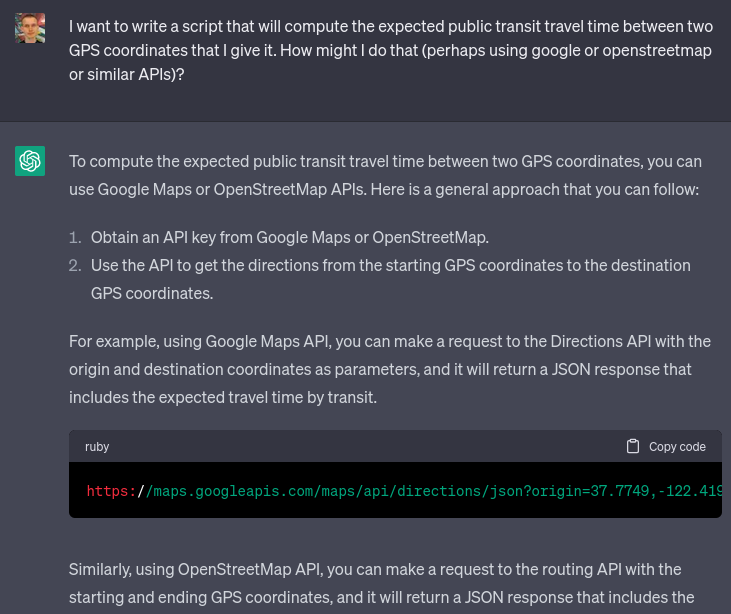
Travel time ~= 750 * distance ^ 0.6 Travel time ~= 750 * distance ^ 0.62023 Apr 14 See all posts Travel time ~= 750 * distance ^ 0.6 As another exercise in using ChatGPT 3.5 to do weird things and seeing what happens, I decided to explore an interesting question: how does the time it takes to travel from point A to point B scale with distance, in the real world? That is to say, if you sample randomly from positions where people are actually at (so, for example, 56% of points you choose would be in cities), and you use public transportation, how does travel time scale with distance?Obviously, travel time would grow slower than linearly: the further you have to go, the more opportunity you have to resort to forms of transportation that are faster, but have some fixed overhead. Outside of a very few lucky cases, there is no practical way to take a bus to go faster if your destination is 170 meters away, but if your destination is 170 kilometers away, you suddenly get more options. And if it's 1700 kilometers away, you get airplanes.So I asked ChatGPT for the ingredients I would need: I went with the GeoLife dataset. I did notice that while it claims to be about users around the world, primarily it seems to focus on people in Seattle and Beijing, though they do occasionally visit other cities. That said, I'm not a perfectionist and I was fine with it. I asked ChatGPT to write me a script to interpret the dataset and extract a randomly selected coordinate from each file: Amazingly, it almost succeeded on the first try. It did make the mistake of assuming every item in the list would be a number (values = [float(x) for x in line.strip().split(',')]), though perhaps to some extent that was my fault: when I said "the first two values" it probably interpreted that as implying that the entire line was made up of "values" (ie. numbers).I fixed the bug manually. Now, I have a way to get some randomly selected points where people are at, and I have an API to get the public transit travel time between the points.I asked it for more coding help:Asking how to get an API key for the Google Maps Directions API (it gave an answer that seems to be outdated, but that succeeded at immediately pointing me to the right place) Writing a function to compute the straight-line distance between two GPS coordinates (it gave the correct answer on the first try) Given a list of (distance, time) pairs, drawing a scatter plot, with time and distance as axes, both axes logarithmically scaled (it gave the correct answer on the first try) Doing a linear regression on the logarithms of distance and time to try to fit the data to a power law (it bugged on the first try, succeeded on the second) This gave me some really nice data (this is filtered for distances under 500km, as above 500km the best path almost certainly includes flying, and the Google Maps directions don't take into account flights): The power law fit that the linear regression gave is: travel_time = 965.8020738916074 * distance^0.6138556361612214 (time in seconds, distance in km).Now, I needed travel time data for longer distances, where the optimal route would include flights. Here, APIs could not help me: I asked ChatGPT if there were APIs that could do such a thing, and it did not give a satisfactory answer. I resorted to doing it manually:I used the same script, but modified it slightly to only output pairs of points which were more than 500km apart from each other. I took the first 8 results within the United States, and the first 8 with at least one end outside the United States, skipping over results that represented a city pair that had already been covered. For each result I manually obtained: to_airport: the public transit travel time from the starting point to the nearest airport, using Google Maps outside China and Baidu Maps inside China. from_airport: the public transit travel time to the end point from the nearest airport flight_time: the flight time from the starting point to the end point. I used Google Flights) and always took the top result, except in cases where the top result was completely crazy (more than 2x the length of the shortest), in which case I took the shortest. I computed the travel time as (to_airport) * 1.5 + (90 if international else 60) + flight_time + from_airport. The first part is a fairly aggressive formula (I personally am much more conservative than this) for when to leave for the airport: aim to arrive 60 min before if domestic and 90 min before if international, and multiply expected travel time by 1.5x in case there are any mishaps or delays. This was boring and I was not interested in wasting my time to do more than 16 of these; I presume if I was a serious researcher I would already have an account set up on TaskRabbit or some similar service that would make it easier to hire other people to do this for me and get much more data. In any case, 16 is enough; I put my resulting data here.Finally, just for fun, I added some data for how long it would take to travel to various locations in space: the moon (I added 12 hours to the time to take into account an average person's travel time to the launch site), Mars, Pluto and Alpha Centauri. You can find my complete code here.Here's the resulting chart: travel_time = 733.002223593754 * distance^0.591980777827876 WAAAAAT?!?!! From this chart it seems like there is a surprisingly precise relationship governing travel time from point A to point B that somehow holds across such radically different transit media as walking, subways and buses, airplanes and (!!) interplanetary and hypothetical interstellar spacecraft. I swear that I am not cherrypicking; I did not throw out any data that was inconvenient, everything (including the space stuff) that I checked I put on the chart.ChatGPT 3.5 worked impressively well this time; it certainly stumbled and fell much less than my previous misadventure, where I tried to get it to help me convert IPFS bafyhashes into hex. In general, ChatGPT seems uniquely good at teaching me about libraries and APIs I've never heard of before but that other people use all the time; this reduces the barrier to entry between amateurs and professionals which seems like a very positive thing.So there we go, there seems to be some kind of really weird fractal law of travel time. Of course, different transit technologies could change this relationship: if you replace public transit with cars and commercial flights with private jets, travel time becomes somewhat more linear. And once we upload our minds onto computer hardware, we'll be able to travel to Alpha Centauri on much crazier vehicles like ultralight craft propelled by Earth-based lightsails) that could let us go anywhere at a significant fraction of the speed of light. But for now, it does seem like there is a strangely consistent relationship that puts time much closer to the square root of distance.
-
Don't overload Ethereum's consensus Don't overload Ethereum's consensus2023 May 21 See all posts Don't overload Ethereum's consensus Special thanks to Karl Floersch and Justin Drake for feedback and reviewThe Ethereum network's consensus is one of the most highly secured cryptoeconomic systems out there. 18 million ETH (~$34 billion) worth of validators finalize a block every 6.4 minutes, running many different implementations of the protocol for redundancy. And if the cryptoeconomic consensus fails, whether due to a bug or an intentional 51% attack, a vast community of many thousands of developers and many more users are watching carefully to make sure the chain recovers correctly. Once the chain recovers, protocol rules ensure that attackers will likely be heavily penalized.Over the years there have been a number of ideas, usually at the thought experiment stage, to also use the Ethereum validator set, and perhaps even the Ethereum social consensus, for other purposes:The ultimate oracle: a proposal where users can vote on what facts are true by sending ETH, with a SchellingCoin mechanism: everyone who sent ETH to vote for the majority answer gets a proportional share of all the ETH sent to vote for the minority answer. The description continues: "So in principle this is an symmetric game. What breaks the symmetry is that a) the truth is the natural point to coordinate on and more importantly b) the people betting on the truth can make a credible thread of forking Ethereum if they loose." Re-staking: a set of techniques, used by many protocols including EigenLayer, where Ethereum stakers can simultaneously use their stake as a deposit in another protocol. In some cases, if they misbehave according to the other protocol's rules, their deposit also gets slashed. In other cases, there are no in-protocol incentives and stake is simply used to vote. L1-driven recovery of L2 projects: it has been proposed on many occasions that if an L2 has a bug, the L1 could fork to recover it. One recent example is this design for using L1 soft forks to recover L2 failures. The purpose of this post will be to explain in detail the argument why, in my view, a certain subset of these techniques brings high systemic risks to the ecosystem and should be discouraged and resisted.These proposals are generally made in a well-intentioned way, and so the goal is not to focus on individuals or projects; rather, the goal is to focus on techniques. The general rule of thumb that this post will attempt to defend is as follows: dual-use of validator staked ETH, while it has some risks, is fundamentally fine, but attempting to "recruit" Ethereum social consensus for your application's own purposes is not.Examples of the distinction between re-using validators (low-risk) and overloading social consensus (high-risk)Alice creates a web3 social network where if you cryptographically prove that you control the key of an active Ethereum validator, you automatically gain "verified" status. Low-risk. Bob cryptographically proves that he controls the key of ten active Ethereum validators as a way of proving that he has enough wealth to satisfy some legal requirement. Low-risk. Charlie claims to have disproven the twin primes conjecture, and claims to know the largest p such that p and p+2 are both prime. He changes his staking withdrawal address to a smart contract where anyone can submit a claimed counterexample q > p, along with a SNARK proving that q and q+2 are both prime. If someone makes a valid claim, then Charlie's validator is forcibly exited, and the submitter gets whatever of Charlie's ETH is left. Low-risk. Dogecoin decides to switch to proof of stake, and to increase the size of its security pool it allows Ethereum stakers to "dual-stake" and simultaneously join its validator set. To do so, Ethereum stakers would have to change their staking withdrawal address to a smart contract where anyone can submit a proof that they violated the Dogecoin staking rules. If someone does submit such a proof, then the staker's validator is forcibly exited, and whatever of their ETH is left is used to buy-and-burn DOGE. Low-risk. eCash does the same as Dogecoin, but the project leaders further announce: if the majority of participating ETH validators collude to censor eCash transactions, they expect that the Ethereum community will hard-fork to delete those validators. They argue that it will be in Ethereum's interest to do so as those validators are proven to be malicious and unreliable. High-risk. Fred creates an ETH/USD price oracle, which functions by allowing Ethereum validators to participate and vote. There are no incentives. Low-risk. George creates an ETH/USD price oracle, which functions by allowing ETH holders to participate and vote. To protect against laziness and creeping bribes, they add an incentive mechanism where the participants that give an answer within 1% of the median answer get 1% of the ETH of any participants that gave an answer further than 1% from the median. When asked "what if someone credibly offers to bribe all the participants, everyone starts submitting the wrong answer, and so honest people get 10 million of their ETH taken away?", George replies: then Ethereum will have to fork out the bad participants' money. High-risk. George conspicuously stays away from making replies. Medium-high risk (as the project could create incentives to attempt such a fork, and hence the expectation that it will be attmpted, even without formal encouragement) George replies: "then the attacker wins, and we'll give up on using this oracle". Medium-low risk (not quite "low" only because the mechanism does create a large set of actors who in a 51% attack might be incentivized to indepently advocate for a fork to protect their deposits) Hermione creates a successful layer 2, and argues that because her layer 2 is the largest, it is inherently the most secure, because if there is a bug that causes funds to be stolen, the losses will be so large that the community will have no choice but to fork to recover the users' funds. High-risk. If you're designing a protocol where, even if everything completely breaks, the losses are kept contained to the validators and users who opted in to participating in and using your protocol, this is low-risk. If, on the other hand, you have the intent to rope in the broader Ethereum ecosystem social consensus to fork or reorg to solve your problems, this is high-risk, and I argue that we should strongly resist all attempts to create such expectations.A middle ground is situations that start off in the low-risk category but give their participants incentives to slide into the higher-risk category; SchellingCoin-style techniques, especially mechanisms with heavy penalties for deviating from the majority, are a major example.So what's so wrong with stretching Ethereum consensus, anyway?It is the year 2025. Frustrated with the existing options, a group has decided to make a new ETH/USD price oracle, which works by allowing validators to vote on the price every hour. If a validator votes, they would be unconditionally rewarded with a portion of fees from the system. But soon participants became lazy: they connected to centralized APIs, and when those APIs got cyber-attacked, they either dropped out or started reporting false values. To solve this, incentives were introduced: the oracle also votes retrospectively on the price one week ago, and if your (real time or retrospective) vote is more than 1% away from the median retrospective vote, you are heavily penalized, with the penalty going to those who voted "correctly".Within a year, over 90% of validators are participating. Someone asked: what if Lido bands together with a few other large stakers to 51% attack the vote, forcing through a fake ETH/USD price value, extracting heavy penalties from everyone who does not participate in the attack? The oracle's proponents, at this point heavily invested in the scheme, reply: well if that happens, Ethereum will surely fork to kick the bad guys out.At first, the scheme is limited to ETH/USD, and it appears resilient and stable. But over the years, other indices get added: ETH/EUR, ETH/CNY, and eventually rates for all countries in the G20.But in 2034, things start to go wrong. Brazil has an unexpectedly severe political crisis, leading to a disputed election. One political party ends up in control of the capital and 75% of the country, but another party ends up in control of some northern areas. Major Western media argue that the northern party is clearly the legitimate winner because it acted legally and the southern party acted illegally (and by the way are fascist). Indian and Chinese official sources, and Elon Musk, argue that the southern party has actual control of most of the country, and the international community should not try to be a world police and should instead accept the outcome.By this point, Brazil has a CBDC, which splits into two forks: the (northern) BRL-N, and the (southern) BRL-S. When voting in the oracle, 60% of Ethereum stakers provide the ETH/BRL-S rate. Major community leaders and businesses decry the stakers' craven capitulation to fascism, and propose to fork the chain to only include the "good stakers" providing the ETH/BRL-N rate, and drain the other stakers' balances to near-zero. Within their social media bubble, they believe that they will clearly win. However, once the fork hits, the BRL-S side proves unexpectedly strong. What they expected to be a landslide instead proves to be pretty much a 50-50 community split.At this point, the two sides are in their two separate universes with their two chains, with no practical way of coming back together. Ethereum, a global permissionless platform created in part to be a refuge from nations and geopolitics, instead ends up cleaved in half by any one of the twenty G20 member states having an unexpectedly severe internal issue.That's a nice scifi story you got there. Could even make a good movie. But what can we actually learn from it?A blockchain's "purity", in the sense of it being a purely mathematical construct that attempts to come to consensus only on purely mathematical things, is a huge advantage. As soon as a blockchain tries to "hook in" to the outside world, the outside world's conflicts start to impact on the blockchain too. Given a sufficiently extreme political event - in fact, not that extreme a political event, given that the above story was basically a pastiche of events that have actually happened in various major (>25m population) countries all within the past decade - even something as benign as a currency oracle could tear the community apart.Here are a few more possible scenarios:One of the currencies that the oracle tracks (which could even be USD) simply hyperinflates, and markets break down to the point that at some points in time there is no clear specific market price. If Ethereum adds a price oracle to another cryptocurrency, then a controversial split like in the story above is not hypothetical: it's something that has already happened, including in the histories of both Bitcoin and Ethereum itself. If strict capital controls become operational, then which price to report as the legitimate market price between two currencies becomes a political question. But more importantly, I'd argue that there is a Schelling fence at play: once a blockchain starts incorporating real-world price indices as a layer-1 protocol feature, it could easily succumb to interpreting more and more real-world information. Introducing layer-1 price indices also expands the blockchain's legal attack surface: instead of being just a neutral technical platform, it becomes much more explicitly a financial tool.What about risks from examples other than price indices?Any expansion of the "duties" of Ethereum's consensus increases the costs, complexities and risks of running a validator. Validators become required to take on the human effort of paying attention and running and updating additional software to make sure that they are acting correctly according to whatever other protocols are being introduced. Other communities gain the ability to externalize their dispute resolution needs onto the Ethereum community. Validators and the Ethereum community as a whole become forced to make far more decisions, each of which has some risk of causing a community split. Even if there is no split, the desire to avoid such pressure creates additional incentives to externalize the decisions to centralized entities through stake-pooling.The possibility of a split would also greatly strengthen perverse too-big-to-fail mechanics. There are so many layer-2 and application-layer projects on Ethereum that it would be impractical for Ethereum social consensus to be willing to fork to solve all of their problems. Hence, larger projects would inevitably get a larger chance of getting a bailout than smaller ones. This would in turn lead to larger projects getting a moat: would you rather have your coins on Arbitrum or Optimism, where if something goes wrong Ethereum will fork to save the day, or on Taiko, where because it's smaller (and non-Western, hence less socially connected to core dev circles), an L1-backed rescue is much less likely?But bugs are a risk, and we need better oracles. So what should we do?The best solutions to these problems are, in my view, case-by-case, because the various problems are inherently so different from each other. Some solutions include:Price oracles: either not-quite-cryptoeconomic decentralized oracles, or validator-voting-based oracles that explicitly commit to their emergency recovery strategies being something other than appealing to L1 consensus for recovery (or some combination of both). For example, a price oracle could count on a trust assumption that voting participants get corrupted slowly, and so users would have early warning of an attack and could exit any systems that depend on the oracle. Such an oracle could intentionally give its reward only after a long delay, so that if that instance of the protocol falls into disuse (eg. because the oracle fails and the community forks toward another version), the participants do not get the reward. More complex truth oracles reporting on facts more subjective than price: some kind of decentralized court system built on a not-quite-cryptoeconomic DAO. Layer 2 protocols: In the short term, rely on partial training wheels (what this post calls stage 1) In the medium term, rely on multiple proving systems. Trusted hardware (eg. SGX) could be included here; I strongly anti-endorse SGX-like systems as a sole guarantor of security, but as a member of a 2-of-3 system they could be valuable. In the longer term, hopefully complex functionalities such as "EVM validation" will themselves eventually be enshrined in the protocol Cross-chain bridges: similar logic as oracles, but also, try to minimize how much you rely on bridges at all: hold assets on the chain where they originate and use atomic swap protocols to move value between different chains. Using the Ethereum validator set to secure other chains: one reason why the (safer) Dogecoin approach in the list of examples above might be insufficient is that while it does protect against 51% finality-reversion attacks, it does not protect against 51% censorship attacks. However, if you are already relying on Ethereum validators, then one possible direction to take is to move away from trying to manage an independent chain entirely, and become a validium with proofs anchored into Ethereum. If a chain does this, its protection against finality-reversion attacks becomes as strong as Ethereum's, and it becomes secure against censorship up to 99% attacks (as opposed to 49%). ConclusionsBlockchain communities' social consensus is a fragile thing. It's necessary - because upgrades happen, bugs happen, and 51% attacks are always a possibility - but because it has such a high risk of causing chain splits, in mature communities it should be used sparingly. There is a natural urge to try to extend the blockchain's core with more and more functionality, because the blockchain's core has the largest economic weight and the largest community watching it, but each such extention makes the core itself more fragile.We should be wary of application-layer projects taking actions that risk increasing the "scope" of blockchain consensus to anything other than verifying the core Ethereum protocol rules. It is natural for application-layer projects to attempt such a strategy, and indeed such ideas are often simply conceived without appreciation of the risks, but its result can easily become very misaligned with the goals of the community as a whole. Such a process has no limiting principle, and could easily lead to a blockchain community having more and more "mandates" over time, pushing it into an uncomfortable choice between a high yearly risk of splitting and some kind of de-facto formalized bureaucracy that has ultimate control of the chain.We should instead preserve the chain's minimalism, support uses of re-staking that do not look like slippery slopes to extending the role of Ethereum consensus, and help developers find alternate strategies to achieve their security goals.
-
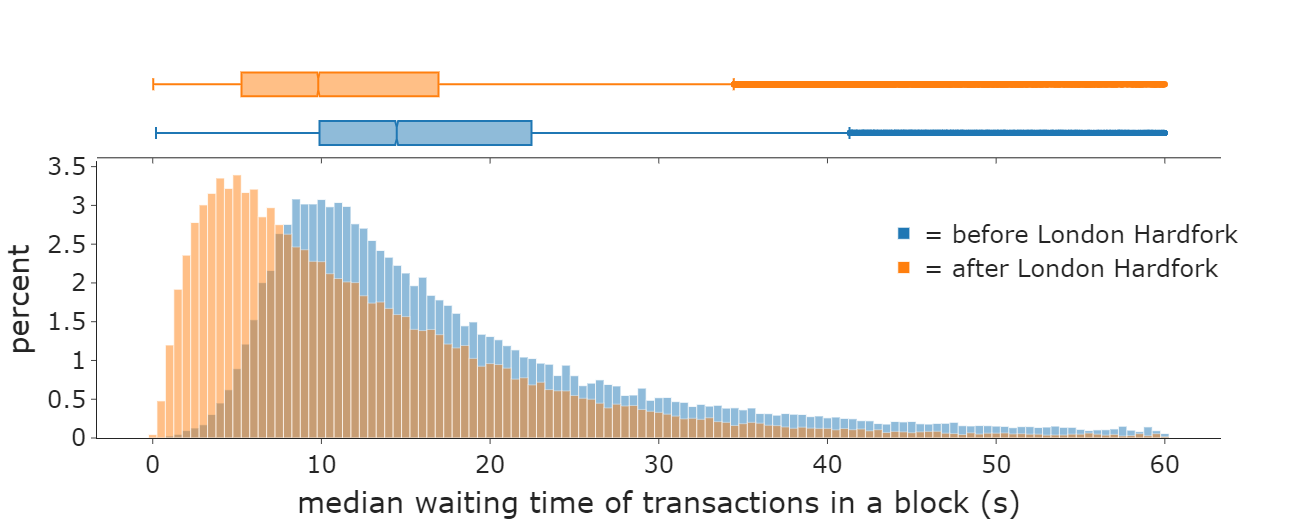
Some personal user experiences Some personal user experiences2023 Feb 28 See all posts Some personal user experiences In 2013, I went to a sushi restaurant beside the Internet Archive in San Francisco, because I had heard that it accepted bitcoin for payments and I wanted to try it out. When it came time to pay the bill, I asked to pay in BTC. I scanned the QR code, and clicked "send". To my surprise, the transaction did not go through; it appeared to have been sent, but the restaurant was not receiving it. I tried again, still no luck. I soon figured out that the problem was that my mobile internet was not working well at the time. I had to walk over 50 meters toward the Internet Archive nearby to access its wifi, which finally allowed me to send the transaction.Lesson learned: internet is not 100% reliable, and customer internet is less reliable than merchant internet. We need in-person payment systems to have some functionality (NFC, customer shows a QR code, whatever) to allow customers to transfer their transaction data directly to the merchant if that's the best way to get it broadcasted.In 2021, I attempted to pay for tea for myself and my friends at a coffee shop in Argentina. In their defense, they did not intentionally accept cryptocurrency: the owner simply recognized me, and showed me that he had an account at a cryptocurrency exchange, so I suggested to pay in ETH (using cryptocurrency exchange accounts as wallets is a standard way to do in-person payments in Latin America). Unfortunately, my first transaction of 0.003 ETH did not get accepted, probably because it was under the exchange's 0.01 ETH deposit minimum. I sent another 0.007 ETH. Soon, both got confirmed. (I did not mind the 3x overpayment and treated it as a tip).In 2022, I attempted to pay for tea at a different location. The first transaction failed, because the default transaction from my mobile wallet sent with only 21000 gas, and the receiving account was a contract that required extra gas to process the transfer. Attempts to send a second transaction failed, because a UI glitch in my phone wallet made it not possible to scroll down and edit the field that contained the gas limit.Lesson learned: simple-and-robust UIs are better than fancy-and-sleek ones. But also, most users don't even know what gas limits are, so we really just need to have better defaults.Many times, there has been a surprisingly long time delay between my transaction getting accepted on-chain, and the service acknowledging the transaction, even as "unconfirmed". Some of those times, I definitely got worried that there was some glitch with the payment system on their side.Many times, there has been a surprisingly long and unpredictable time delay between sending a transaction, and that transaction getting accepted in a block. Sometimes, a transaction would get accepted in a few seconds, but other times, it would take minutes or even hours. Recently, EIP-1559 significantly improved this, ensuring that most transactions get accepted into the next block, and even more recently the Merge improved things further by stabilizing block times. Diagram from this report by Yinhong (William) Zhao and Kartik Nayak. However, outliers still remain. If you send a transaction at the same time as when many others are sending transactions and the base fee is spiking up, you risk the base fee going too high and your transaction not getting accepted. Even worse, wallet UIs suck at showing this. There are no big red flashing alerts, and very little clear indication of what you're supposed to do to solve this problem. Even to an expert, who knows that in this case you're supposed to "speed up" the transaction by publishing a new transaction with identical data but a higher max-basefee, it's often not clear where the button to do that actually is.Lesson learned: UX around transaction inclusion needs to be improved, though there are fairly simple fixes. Credit to the Brave wallet team for taking my suggestions on this topic seriously, and first increasing the max-basefee tolerance from 12.5% to 33%, and more recently exploring ways to make stuck transactions more obvious in the UI.In 2019, I was testing out one of the earliest wallets that was attempting to provide social recovery. Unlike my preferred approach, which is smart-contract-based, their approach was to use Shamir's secret sharing to split up the private key to the account into five pieces, in such a way that any three of those pieces could be used to recover the private key. Users were expected to choose five friends ("guardians" in modern lingo), convince them to download a separate mobile application, and provide a confirmation code that would be used to create an encrypted connection from the user's wallet to the friend's application through Firebase and send them their share of the key.This approach quickly ran into problems for me. A few months later, something happened to my wallet and I needed to actually use the recovery procedure to recover it. I asked my friends to perform the recovery procedure with me through their apps - but it did not go as planned. Two of them lost their key shards, because they switched phones and forgot to move the recovery application over. For a third, the Firebase connection mechanism did not work for a long time. Eventually, we figured out how to fix the issue, and recover the key. A few months after that, however, the wallet broke again. This time, a regular software update somehow accidentally reset the app's storage and deleted its key. But I had not added enough recovery partners, because the Firebase connection mechanism was too broken and was not letting me successfully do that. I ended up losing a small amount of BTC and ETH.Lesson learned: secret-sharing-based off-chain social recovery is just really fragile and a bad idea unless there are no other options. Your recovery guardians should not have to download a separate application, because if you have an application only for an exceptional situation like recovery, it's too easy to forget about it and lose it. Additionally, requiring separate centralized communication channels comes with all kinds of problems. Instead, the way to add guardians should be to provide their ETH address, and recovery should be done by smart contract, using ERC-4337 account abstraction wallets. This way, the guardians would only need to not lose their Ethereum wallets, which is something that they already care much more about not losing for other reasons.In 2021, I was attempting to save on fees when using Tornado Cash, by using the "self-relay" option. Tornado Cash uses a "relay" mechanism where a third party pushes the transaction on-chain, because when you are withdrawing you generally do not yet have coins in your withdrawal address, and you don't want to pay for the transaction with your deposit address because that creates a public link between the two addresses, which is the whole problem that Tornado Cash is trying to prevent. The problem is that the relay mechanism is often expensive, with relays charging a percentage fee that could go far above the actual gas fee of the transaction.To save costs, one time I used the relay for a first small withdrawal that would charge lower fees, and then used the "self-relay" feature in Tornado Cash to send a second larger withdrawal myself without using relays. The problem is, I screwed up and accidentally did this while logged in to my deposit address, so the deposit address paid the fee instead of the withdrawal address. Oops, I created a public link between the two.Lesson learned: wallet developers should start thinking much more explicitly about privacy. Also, we need better forms of account abstraction to remove the need for centralized or even federated relays, and commoditize the relaying role.Miscellaneous stuffMany apps still do not work with the Brave wallet or the Status browser; this is likely because they didn't do their homework properly and rely on Metamask-specific APIs. Even Gnosis Safe did not work with these wallets for a long time, leading me to have to write my own mini Javascript dapp to make confirmations. Fortunately, the latest UI has fixed this issue. The ERC20 transfers pages on Etherscan (eg. https://etherscan.io/address/0xd8da6bf26964af9d7eed9e03e53415d37aa96045#tokentxns) are very easy to spam with fakes. Anyone can create a new ERC20 token with logic that can issue a log that claims that I or any other specific person sent someone else tokens. This is sometimes used to trick people into thinking that I support some scam token when I actually have never even heard of it. Uniswap used to offer the functionality of being able to swap tokens and have the output sent to a different address. This was really convenient for when I have to pay someone in USDC but I don't have any already on me. Now, the interface doesn't offer that function, and so I have to convert and then send in a separate transaction, which is less convenient and wastes more gas. I have since learned that Cowswap and Paraswap offer the functionality, though Paraswap... currently does not seem to work with the Brave wallet. Sign in with Ethereum is great, but it's still difficult to use if you are trying to sign in on multiple devices, and your Ethereum wallet is only available on one device. ConclusionsGood user experience is not about the average case, it is about the worst case. A UI that is clean and sleek, but does some weird and unexplainable thing 0.723% of the time that causes big problems, is worse than a UI that exposes more gritty details to the user but at least makes it easier to understand what's going on and fix any problem that does arise.Along with the all-important issue of high transaction fees due to scaling not yet being fully solved, user experience is a key reason why many Ethereum users, especially in the Global South, often opt for centralized solutions instead of on-chain decentralized alternatives that keep power in the hands of the user and their friends and family or local community. User experience has made great strides over the years - in particular, going from an average transaction taking minutes to get included before EIP-1559 to an average transaction taking seconds to get included after EIP-1559 and the merge, has been a night-and-day change to how pleasant it is to use Ethereum. But more still needs to be done.
-
How will Ethereum's multi-client philosophy interact with ZK-EVMs? How will Ethereum's multi-client philosophy interact with ZK-EVMs?2023 Mar 31 See all posts How will Ethereum's multi-client philosophy interact with ZK-EVMs? Special thanks to Justin Drake for feedback and reviewOne underdiscussed, but nevertheless very important, way in which Ethereum maintains its security and decentralization is its multi-client philosophy. Ethereum intentionally has no "reference client" that everyone runs by default: instead, there is a collaboratively-managed specification (these days written in the very human-readable but very slow Python) and there are multiple teams making implementations of the spec (also called "clients"), which is what users actually run. Each Ethereum node runs a consensus client and an execution client. As of today, no consensus or execution client makes up more than 2/3 of the network. If a client with less than 1/3 share in its category has a bug, the network would simply continue as normal. If a client with between 1/3 and 2/3 share in its category (so, Prysm, Lighthouse or Geth) has a bug, the chain would continue adding blocks, but it would stop finalizing blocks, giving time for developers to intervene. One underdiscussed, but nevertheless very important, major upcoming transition in the way the Ethereum chain gets validated is the rise of ZK-EVMs. SNARKs proving EVM execution have been under development for years already, and the technology is actively being used by layer 2 protocols called ZK rollups. Some of these ZK rollups are active on mainnet today, with more coming soon. But in the longer term, ZK-EVMs are not just going to be for rollups; we want to use them to verify execution on layer 1 as well (see also: the Verge).Once that happens, ZK-EVMs de-facto become a third type of Ethereum client, just as important to the network's security as execution clients and consensus clients are today. And this naturally raises a question: how will ZK-EVMs interact with the multi-client philosophy? One of the hard parts is already done: we already have multiple ZK-EVM implementations that are being actively developed. But other hard parts remain: how would we actually make a "multi-client" ecosystem for ZK-proving correctness of Ethereum blocks? This question opens up some interesting technical challenges - and of course the looming question of whether or not the tradeoffs are worth it.What was the original motivation for Ethereum's multi-client philosophy?Ethereum's multi-client philosophy is a type of decentralization, and like decentralization in general, one can focus on either the technical benefits of architectural decentralization or the social benefits of political decentralization. Ultimately, the multi-client philosophy was motivated by both and serves both.Arguments for technical decentralizationThe main benefit of technical decentralization is simple: it reduces the risk that one bug in one piece of software leads to a catastrophic breakdown of the entire network. A historical situation that exemplifies this risk is the 2010 Bitcoin overflow bug. At the time, the Bitcoin client code did not check that the sum of the outputs of a transaction does not overflow (wrap around to zero by summing to above the maximum integer of \(2^ - 1\)), and so someone made a transaction that did exactly that, giving themselves billions of bitcoins. The bug was discovered within hours, and a fix was rushed through and quickly deployed across the network, but had there been a mature ecosystem at the time, those coins would have been accepted by exchanges, bridges and other structures, and the attackers could have gotten away with a lot of money. If there had been five different Bitcoin clients, it would have been very unlikely that all of them had the same bug, and so there would have been an immediate split, and the side of the split that was buggy would have probably lost.There is a tradeoff in using the multi-client approach to minimize the risk of catastrophic bugs: instead, you get consensus failure bugs. That is, if you have two clients, there is a risk that the clients have subtly different interpretations of some protocol rule, and while both interpretations are reasonable and do not allow stealing money, the disagreement would cause the chain to split in half. A serious split of that type happened once in Ethereum's history (there have been other much smaller splits where very small portions of the network running old versions of the code forked off). Defenders of the single-client approach point to consensus failures as a reason to not have multiple implementations: if there is only one client, that one client will not disagree with itself. Their model of how number of clients translates into risk might look something like this: I, of course, disagree with this analysis. The crux of my disagreement is that (i) 2010-style catastrophic bugs matter too, and (ii) you never actually have only one client. The latter point is made most obvious by the Bitcoin fork of 2013: a chain split occurred because of a disagreement between two different versions of the Bitcoin client, one of which turned out to have an accidental and undocumented limit on the number of objects that could be modified in a single block. Hence, one client in theory is often two clients in practice, and five clients in theory might be six or seven clients in practice - so we should just take the plunge and go on the right side of the risk curve, and have at least a few different clients.Arguments for political decentralizationMonopoly client developers are in a position with a lot of political power. If a client developer proposes a change, and users disagree, theoretically they could refuse to download the updated version, or create a fork without it, but in practice it's often difficult for users to do that. What if a disagreeable protocol change is bundled with a necessary security update? What if the main team threatens to quit if they don't get their way? Or, more tamely, what if the monopoly client team ends up being the only group with the greatest protocol expertise, leaving the rest of the ecosystem in a poor position to judge technical arguments that the client team puts forward, leaving the client team with a lot of room to push their own particular goals and values, which might not match with the broader community?Concern about protocol politics, particularly in the context of the 2013-14 Bitcoin OP_RETURN wars where some participants were openly in favor of discriminating against particular usages of the chain, was a significant contributing factor in Ethereum's early adoption of a multi-client philosophy, which was aimed to make it harder for a small group to make those kinds of decisions. Concerns specific to the Ethereum ecosystem - namely, avoiding concentration of power within the Ethereum Foundation itself - provided further support for this direction. In 2018, a decision was made to intentionally have the Foundation not make an implementation of the Ethereum PoS protocol (ie. what is now called a "consensus client"), leaving that task entirely to outside teams.How will ZK-EVMs come in on layer 1 in the future?Today, ZK-EVMs are used in rollups. This increases scaling by allowing expensive EVM execution to happen only a few times off-chain, with everyone else simply verifying SNARKs posted on-chain that prove that the EVM execution was computed correctly. It also allows some data (particularly signatures) to not be included on-chain, saving on gas costs. This gives us a lot of scalability benefits, and the combination of scalable computation with ZK-EVMs and scalable data with data availability sampling could let us scale very far.However, the Ethereum network today also has a different problem, one that no amount of layer 2 scaling can solve by itself: the layer 1 is difficult to verify, to the point where not many users run their own node. Instead, most users simply trust third-party providers. Light clients such as Helios and Succinct are taking steps toward solving the problem, but a light client is far from a fully verifying node: a light client merely verifies the signatures of a random subset of validators called the sync committee, and does not verify that the chain actually follows the protocol rules. To bring us to a world where users can actually verify that the chain follows the rules, we would have to do something different.Option 1: constrict layer 1, force almost all activity to move to layer 2We could over time reduce the layer 1 gas-per-block target down from 15 million to 1 million, enough for a block to contain a single SNARK and a few deposit and withdraw operations but not much else, and thereby force almost all user activity to move to layer 2 protocols. Such a design could still support many rollups committing in each block: we could use off-chain aggregation protocols run by customized builders to gather together SNARKs from multiple layer 2 protocols and combine them into a single SNARK. In such a world, the only function of layer 1 would be to be a clearinghouse for layer 2 protocols, verifying their proofs and occasionally facilitating large funds transfers between them. This approach could work, but it has several important weaknesses:It's de-facto backwards-incompatible, in the sense that many existing L1-based applications become economically nonviable. User funds up to hundreds or thousands of dollars could get stuck as fees become so high that they exceed the cost of emptying those accounts. This could be addressed by letting users sign messages to opt in to an in-protocol mass migration to an L2 of their choice (see some early implementation ideas here), but this adds complexity to the transition, and making it truly cheap enough would require some kind of SNARK at layer 1 anyway. I'm generally a fan of breaking backwards compatibility when it comes to things like the SELFDESTRUCT opcode, but in this case the tradeoff seems much less favorable. It might still not make verification cheap enough. Ideally, the Ethereum protocol should be easy to verify not just on laptops but also inside phones, browser extensions, and even inside other chains. Syncing the chain for the first time, or after a long time offline, should also be easy. A laptop node could verify 1 million gas in ~20 ms, but even that implies 54 seconds to sync after one day offline (assuming single slot finality increases slot times to 32s), and for phones or browser extensions it would take a few hundred milliseconds per block and might still be a non-negligible battery drain. These numbers are manageable, but they are not ideal. Even in an L2-first ecosystem, there are benefits to L1 being at least somewhat affordable. Validiums can benefit from a stronger security model if users can withdraw their funds if they notice that new state data is no longer being made available. Arbitrage becomes more efficient, especially for smaller tokens, if the minimum size of an economically viable cross-L2 direct transfer is smaller. Hence, it seems more reasonable to try to find a way to use ZK-SNARKs to verify the layer 1 itself.Option 2: SNARK-verify the layer 1A type 1 (fully Ethereum-equivalent) ZK-EVM can be used to verify the EVM execution of a (layer 1) Ethereum block. We could write more SNARK code to also verify the consensus side of a block. This would be a challenging engineering problem: today, ZK-EVMs take minutes to hours to verify Ethereum blocks, and generating proofs in real time would require one or more of (i) improvements to Ethereum itself to remove SNARK-unfriendly components, (ii) either large efficiency gains with specialized hardware, and (iii) architectural improvements with much more parallelization. However, there is no fundamental technological reason why it cannot be done - and so I expect that, even if it takes many years, it will be done.Here is where we see the intersection with the multi-client paradigm: if we use ZK-EVMs to verify layer 1, which ZK-EVM do we use?I see three options:Single ZK-EVM: abandon the multi-client paradigm, and choose a single ZK-EVM that we use to verify blocks. Closed multi ZK-EVM: agree on and enshrine in consensus a specific set of multiple ZK-EVMs, and have a consensus-layer protocol rule that a block needs proofs from more than half of the ZK-EVMs in that set to be considered valid. Open multi ZK-EVM: different clients have different ZK-EVM implementations, and each client waits for a proof that is compatible with its own implementation before accepting a block as valid. To me, (3) seems ideal, at least until and unless our technology improves to the point where we can formally prove that all of the ZK-EVM implementations are equivalent to each other, at which point we can just pick whichever one is most efficient. (1) would sacrifice the benefits of the multi-client paradigm, and (2) would close off the possibility of developing new clients and lead to a more centralized ecosystem. (3) has challenges, but those challenges seem smaller than the challenges of the other two options, at least for now.Implementing (3) would not be too hard: one might have a p2p sub-network for each type of proof, and a client that uses one type of proof would listen on the corresponding sub-network and wait until they receive a proof that their verifier recognizes as valid.The two main challenges of (3) are likely the following:The latency challenge: a malicious attacker could publish a block late, along with a proof valid for one client. It would realistically take a long time (even if eg. 15 seconds) to generate proofs valid for other clients. This time would be long enough to potentially create a temporary fork and disrupt the chain for a few slots. Data inefficiency: one benefit of ZK-SNARKs is that data that is only relevant to verification (sometimes called "witness data") could be removed from a block. For example, once you've verified a signature, you don't need to keep the signature in a block, you could just store a single bit saying that the signature is valid, along with a single proof in the block confirming that all of the valid signatures exist. However, if we want it to be possible to generate proofs of multiple types for a block, the original signatures would need to actually be published. The latency challenge could be addressed by being careful when designing the single-slot finality protocol. Single-slot finality protocols will likely require more than two rounds of consensus per slot, and so one could require the first round to include the block, and only require nodes to verify proofs before signing in the third (or final) round. This ensures that a significant time window is always available between the deadline for publishing a block and the time when it's expected for proofs to be available.The data efficiency issue would have to be addressed by having a separate protocol for aggregating verification-related data. For signatures, we could use BLS aggregation, which ERC-4337 already supports. Another major category of verification-related data is ZK-SNARKs used for privacy. Fortunately, these often tend to have their own aggregation protocols.It is also worth mentioning that SNARK-verifying the layer 1 has an important benefit: the fact that on-chain EVM execution no longer needs to be verified by every node makes it possible to greatly increase the amount of EVM execution taking place. This could happen either by greatly increasing the layer 1 gas limit, or by introducing enshrined rollups, or both.ConclusionsMaking an open multi-client ZK-EVM ecosystem work well will take a lot of work. But the really good news is that much of this work is happening or will happen anyway:We have multiple strong ZK-EVM implementations already. These implementations are not yet type 1 (fully Ethereum-equivalent), but many of them are actively moving in that direction. The work on light clients such as Helios and Succinct may eventually turn into a more full SNARK-verification of the PoS consensus side of the Ethereum chain. Clients will likely start experimenting with ZK-EVMs to prove Ethereum block execution on their own, especially once we have stateless clients and there's no technical need to directly re-execute every block to maintain the state. We will probably get a slow and gradual transition from clients verifying Ethereum blocks by re-executing them to most clients verifying Ethereum blocks by checking SNARK proofs. The ERC-4337 and PBS ecosystems are likely to start working with aggregation technologies like BLS and proof aggregation pretty soon, in order to save on gas costs. On BLS aggregation, work has already started. With these technologies in place, the future looks very good. Ethereum blocks would be smaller than today, anyone could run a fully verifying node on their laptop or even their phone or inside a browser extension, and this would all happen while preserving the benefits of Ethereum's multi-client philosophy.In the longer-term future, of course anything could happen. Perhaps AI will super-charge formal verification to the point where it can easily prove ZK-EVM implementations equivalent and identify all the bugs that cause differences between them. Such a project may even be something that could be practical to start working on now. If such a formal verification-based approach succeeds, different mechanisms would need to be put in place to ensure continued political decentralization of the protocol; perhaps at that point, the protocol would be considered "complete" and immutability norms would be stronger. But even if that is the longer-term future, the open multi-client ZK-EVM world seems like a natural stepping stone that is likely to happen anyway.In the nearer term, this is still a long journey. ZK-EVMs are here, but ZK-EVMs becoming truly viable at layer 1 would require them to become type 1, and make proving fast enough that it can happen in real time. With enough parallelization, this is doable, but it will still be a lot of work to get there. Consensus changes like raising the gas cost of KECCAK, SHA256 and other hash function precompiles will also be an important part of the picture. That said, the first steps of the transition may happen sooner than we expect: once we switch to Verkle trees and stateless clients, clients could start gradually using ZK-EVMs, and a transition to an "open multi-ZK-EVM" world could start happening all on its own.
-
What even is an institution? What even is an institution?2022 Dec 30 See all posts What even is an institution? Special thanks to Dennis Pourteaux and Tina Zhen for discussion that led to this post.A recent alternative political compass proposed by Dennis Pourteaux proposes that the most important political divide of our present time is not liberty vs authoritarianism or left vs right, but rather how we think about "institutions". Are the institutions that society runs on today good or bad, and is the solution to work incrementally to improve them, replace them with radically different institutions, or do away with institutions altogether? This, however, raises a really important question: what even is an "institution" anyway?The word "institution" in political discourse brings to mind things like national governments, the New York Times, universities and maybe the local public library. But the word also gets used to describe other kinds of things. The phrase "the institution of marriage" is common in English-language discourse, and gets over two million search results on Google. If you ask Google point-blank, "is family an institution", it answers yes. ChatGPT agrees: If we take ChatGPT's definition that "a social institution is a pattern of behaviors and norms that exist within a society and are thought to be essential to its functioning" seriously, then the New York Times is not an institution - no one argues that it's literally essential, and many people consider it to be actively harmful! And on the other side, we can think of examples of things that maybe are institutions that Pourteaux's "anti-institutionalists" would approve of!Twitter The Bitcoin or Ethereum blockchains The English language Substack Markets Standards organizations dealing with international shipping This leads us to two related, but also somewhat separate, questions:What is really the dividing line that makes some things "institutions" in people's eyes and others not? What kind of world do people who consider themselves anti-institutionalists actually want to see? And what should an anti-institutionalist in today's world be doing? A survey experimentOver the past week, I made a series of polls on Mastodon where I provided many examples of different objects, practices and social structures, and asked: is this an institution or not? In some cases, I made different spins on the same concept to see the effects of changing some specific variables. There were some fascinating results.Here are a few examples:And:And:And, of course:There's more fun ones: NYT vs Russia Today vs Bitcoin Magazine, the solar system vs what if we started re-engineering it, prediction markets, various social customs, and a lot more.Here, we can already start to see some common factors. Marriage is more institution-y than romantic relationships, likely because of its official stamp of recognition, and more mainstream relationship styles are more institution-y than less mainstream styles (a pattern that repeats itself when comparing NYT vs Russia Today vs Bitcoin Magazine). Systems with clearly visible human beings making decisions are more institution-y than more impersonal algorithmic structures, even if their outputs are ultimately entirely a function of human-provided inputs.To try to elucidate things further, I decided to do a more systematic analysis.What are some common factors?Robin Hanson recently made a post in which he argued that:At least on prestigious topics, most people want relevant institutions to take the following ideal form:Masses recognize elites, who oversee experts, who pick details.This seemed to me to be an important and valuable insight, though in a somewhat different direction: yes, that is the style of institution that people find familiar and are not weirded out by (as they might when they see many of the "alternative institutions" that Hanson likes to propose), but it's also exactly the style of institutions that anti-institutionalists tend to most strongly rail against! Mark Zuckerberg's very institution-y oversight board certainly followed the "masses recognize elites who oversee experts" template fairly well, but it did not really make a lot of people happy.I decided to give this theory of institution-ness, along with some other theories, a test. I identified seven properties that seemed to me possible important characteristics of institutions, with the goal of identifying which ones are most strongly correlated to people thinking of something as being an institution:Does it have a "masses recognize elites" pattern? Does it have a "elites oversee experts" pattern? Is it mainstream? Is it logically centralized? Does it involve interaction between people? (eg. intermittent fasting doesn't, as everyone just chooses whether or not to do it separately, but a government does) Does it have a specific structure that has a lot of intentional design behind it? (eg. corporations do, friendship doesn't) Does it have roles that take on a life independent of the individuals that fill them? (eg. democratically elected governments do, after all they even call the leader "Mr. President", but a podcast which is named after its sole host does not at all) I went through the list and personally graded the 35 maybe-institutions from my polls on these categories. For example, Tesla got:25% on "masses recognize elites" (because it's run by Elon Musk, who does in practice have a lot of recognition and support as a celebrity, but this isn't a deeply intrinsic feature of Tesla, Elon won't get kicked out of Tesla if he loses legitimacy, etc) 100% on "elites oversee experts" (all large corporations follow this pattern) 75% on "is mainstream" (almost everyone knows about it, lots of people have them, but it's not quite a New York Times-level household name) 100% on "logical centralization" (most things get 100% on this score; as a counterexample, "dating sites" get 50% because there are many dating sites and "intermittent fasting" gets 0%) 100% on "involves interaction between people" (Tesla produces products that it sells to people, and it hires employees, has investors, etc) 75% on "intentional structure" (Tesla definitely has a deep structure with shareholders, directors, management, etc, but that structure isn't really part of its identity in the way that, say, proof of stake consensus is for Ethereum or voting and congress are for a government) 50% for "roles independent of individuals" (while roles in companies are generally interchangeable, Tesla does get large gains from being part of the Elon-verse specifically) The full data is here. I know that many people will have many disagreements over various individual rankings I make, and readers could probably convince me that a few of my scores are wrong; I am mainly hoping that I've included a sufficient number of diverse maybe-instiutions in the list that individual disagreement or errors get roughly averaged out.Here's the table of correlations:Masses recognize elites 0.491442156943094 Elites oversee experts 0.697483431580409 Is mainstream 0.477135770662517 Logical centralization 0.406758324754985 Interaction between people 0.570201749796132 Intelligently designed structure 0.365640100778201 Roles independent of individuals 0.199412937985826 But as it turns out, the correlations are misleading. "Interaction between people" turns out to be an almost unquestionably necessary property for something to have to be an institution. The correlation of 0.57 kind of shows it, but it understates the strength of the relationship: Literally every thing that I labeled as clearly involving interaction had a higher percentage of people considering it an institution than every thing I labeled as not involving interaction. The single dot in the center is my hypothetical example of an island where people with odd-numbered birthdays are not allowed to eat meat before 12:00; I didn't want to give it 100% because the not-meat-eating is a private activity, but the question still strongly implies some social or other pressure to follow the rule so it's also not really 0%. This is a place where Spearman's coefficient outperforms Pearson's, but rather than spurting out exotic numbers I'd rather just show the charts. Here are the other six:The most surprising finding for me is that "roles independent of individuals" is by far the weakest correlation. Twitter run by a democracy is the most institution-y of all, but Twitter run by a pay-to-govern scheme is as institution-y as Twitter that's just run by Elon directly. Roles being independent of individuals adds a guarantee of stability, but roles being independent of individuals in the wrong way feels too unfamiliar, or casual, or otherwise not institution-like. Dating sites are more independent of individuals than professional matchmaking agencies, and yet it's the matchmaking agencies that are seen as more institution-like. Attempts at highly role-driven and mechanistic credibly-neutral media, (eg. this contraption, which I actually think would be really cool) just feel alien - perhaps in a bad way, but also perhaps in a good way, if you find the institutions of today frustrating and you're open-minded about possible alternatives.Correlations with "masses recognize elites" and "elites oversee experts" were high; higher for the second than the first, though perhaps Hanson and I had different meanings in mind for "recognize". The "intentional structure" chart has an empty bottom-right corner but a full top-left corner, suggesting that intentional structure is necessary but not sufficient for something to be an institution.That said, my main conclusion is probably that the term "institution" is a big mess. Rather than the term "institution" referring to a single coherent cluster of concepts (as eg. "high modernism" does), the term seems to have a number of different definitions at play:A structure that fits the familiar pattern of "masses recognize elites who oversee experts" Any intentionally designed large-scale structure that mediates human interaction (including things like financial markets, social media platforms and dating sites) Widely spread and standardized social customs in general I suspect that anti-institutionalists focus their suspicion on (1), and especially instances of (1) that have been captured by the wrong tribe. Whether a structure is personalistic or role-driven does not seem to be very important to anti-institutionalists: both personalities ("Klaus Schwab") and bureaucracies ("woke academics") are equally capable of coming from the wrong tribe. Anti-institutionalists generally do not oppose (3), and indeed in many cases want to see (3) replace (1) as much as possible.Support for (2) probably maps closely to Pourteaux's "techno-optimist" vs "techno-minimalist" distinction. Techno-minimalists don't see things like Twitter, Substack, Bitcoin, Ethereum, etc as part of the solution, though there are "Bitcoin minimalists" who see the Bitcoin blockchain as a narrow exception and otherwise want to see a world where things like family decide more of the outcomes. "Techno-optimist anti-institutionalists" are specifically engaged in a political project of either trying to replace (1) with the right kind of (2), or trying to reform (1) by introducing more elements of the right kind of (2).Which way forward for anti-institutionalists or institutional reformers?It would be wrong to ascribe too much intentional strategy to anti-institutionalists: anti-institutionalism is a movement that is much more united in what is against than in support of any specific particular alternative. But what is possible is to recognize this pattern, and ask the question of which paths forward make sense for anti-institutionalists.From a language point of view, even using the word "institution" at all seems more likely to confuse than enlighten at this point. There is a crucial difference between (i) a desire to replace structures that contain enshrined elite roles with structures that don't, (ii) a preference for small-scale and informal structures over large-scale and formal ones, (iii) a desire to simply swap the current elites out for new elites, and (iv) a kind of social libertinist position that individuals should be driven by their own whims and not by incentives created by other people. The word "institution" obscures that divide, and probably focuses too much attention on what is being torn down rather than what is to be built up in its place. Different anti-institutionalists have different goals in mind. Sure, the person on Twitter delivering that powerful incisive criticism of the New York Times agrees with you on how society should not be run, but are you sure they'll be your ally when it comes time to decide how society should be run? The challenge with avoiding structures entirely is clear: prisoner's dilemmas exist and we need incentives. The challenge with small-scale and informal structures is often clear: economies of scale and gains from standardization - though sometimes there are other benefits from informal approaches that are worth losing those gains. The challenge with simply swapping the elites is clear: it has no path to socially scale into a cross-tribal consensus. If the goal is not to enshrine a new set of elites forever, but for elites to permanently be high-churn (cf. Balaji's founder vs inheritor dichotomy), that is more credibly neutral, but then it starts getting closer to the territory of avoiding enshrined elites in general.Creating formal structures without enshrined elites is fascinating, not least because it's under-explored: there's a strong case that institutions with enshrined elite roles might be an unfortunate historical necessity from when communication was more constrained, but modern information technology (including the internet and also newer spookier stuff like zero-knowledge cryptography, blockchains and DAOs) could rapidly expand our available options. That said, as Hanson points out, this path has its own fair share of challenges too.
-
An incomplete guide to stealth addresses An incomplete guide to stealth addresses2023 Jan 20 See all posts An incomplete guide to stealth addresses Special thanks to Ben DiFrancesco, Matt Solomon, Toni Wahrstätter and Antonio Sanso for feedback and reviewOne of the largest remaining challenges in the Ethereum ecosystem is privacy. By default, anything that goes onto a public blockchain is public. Increasingly, this means not just money and financial transactions, but also ENS names, POAPs, NFTs, soulbound tokens, and much more. In practice, using the entire suite of Ethereum applications involves making a significant portion of your life public for anyone to see and analyze.Improving this state of affairs is an important problem, and this is widely recognized. So far, however, discussions on improving privacy have largely centered around one specific use case: privacy-preserving transfers (and usually self-transfers) of ETH and mainstream ERC20 tokens. This post will describe the mechanics and use cases of a different category of tool that could improve the state of privacy on Ethereum in a number of other contexts: stealth addresses.What is a stealth address system?Suppose that Alice wants to send Bob an asset. This could be some quantity of cryptocurrency (eg. 1 ETH, 500 RAI), or it could be an NFT. When Bob receives the asset, he does not want the entire world to know that it was he who got it. Hiding the fact that a transfer happened is impossible, especially if it's an NFT of which there is only one copy on-chain, but hiding who is the recipient may be much more viable. Alice and Bob are also lazy: they want a system where the payment workflow is exactly the same as it is today. Bob sends Alice (or registers on ENS) some kind of "address" encoding how someone can pay him, and that information alone is enough for Alice (or anyone else) to send him the asset.Note that this is a different kind of privacy than what is provided by eg. Tornado Cash. Tornado Cash can hide transfers of mainstream fungible assets such as ETH or major ERC20s (though it's most easily useful for privately sending to yourself), but it's very weak at adding privacy to transfers of obscure ERC20s, and it cannot add privacy to NFT transfers at all. The ordinary workflow of making a payment with cryptocurrency. We want to add privacy (no one can tell that it was Bob who received the asset), but keep the workflow the same. Stealth addresses provide such a scheme. A stealth address is an address that can be generated by either Alice or Bob, but which can only be controlled by Bob. Bob generates and keeps secret a spending key, and uses this key to generate a stealth meta-address. He passes this meta-address to Alice (or registers it on ENS). Alice can perform a computation on this meta-address to generate a stealth address belonging to Bob. She can then send any assets she wants to send to this address, and Bob will have full control over them. Along with the transfer, she publishes some extra cryptographic data (an ephemeral pubkey) on-chain that helps Bob discover that this address belongs to him.Another way to look at it is: stealth addresses give the same privacy properties as Bob generating a fresh address for each transaction, but without requiring any interaction from Bob.The full workflow of a stealth address scheme can be viewed as follows:Bob generates his root spending key (m) and stealth meta-address (M). Bob adds an ENS record to register M as the stealth meta-address for bob.eth. We assume Alice knows that Bob is bob.eth. Alice looks up his stealth meta-address M on ENS. Alice generates an ephemeral key that only she knows, and that she only uses once (to generate this specific stealth address). Alice uses an algorithm that combines her ephemeral key and Bob's meta-address to generate a stealth address. She can now send assets to this address. Alice also generates her ephemeral public key, and publishes it to the ephemeral public key registry (this can be done in the same transaction as the first transaction sending assets to this stealth address). For Bob to discover stealth addresses belonging to him, Bob needs to scan the ephemeral public key registry for the entire list of ephemeral public keys published by anyone for any reason since the last time he did the scan. For each ephemeral public key, Bob attempts to combine it with his root spending key to generate a stealth address, and checks if there are any assets in that address. If there are, Bob computes the spending key for that address and remembers it. This all relies on two uses of cryptographic trickery. First, we need a pair of algorithms to generate a shared secret: one algorithm which uses Alice's secret thing (her ephemeral key) and Bob's public thing (his meta-address), and another algorithm which uses Bob's secret thing (his root spending key) and Alice's public thing (her ephemeral public key). This can be done in many ways; Diffie-Hellman key exchange was one of the results that founded the field of modern cryptography, and it accomplishes exactly this.But a shared secret by itself is not enough: if we just generate a private key from the shared secret, then Alice and Bob could both spend from this address. We could leave it at that, leaving it up to Bob to move the funds to a new address, but this is inefficient and needlessly reduces security. So we also add a key blinding mechanism: a pair of algorithms where Bob can combine the shared secret with his root spending key, and Alice can combine the shared secret with Bob's meta-address, in such a way that Alice can generate the stealth address, and Bob can generate the spending key for that stealth address, all without creating a public link between the stealth address and Bob's meta-address (or between one stealth address and another).Stealth addresses with elliptic curve cryptographyStealth addresses using elliptic curve cryptography were originally introduced in the context of Bitcoin by Peter Todd in 2014. This technique works as follows (this assumes prior knowledge of basic elliptic curve cryptography; see here, here and here for some tutorials):Bob generates a key m, and computes M = G * m, where G is a commonly-agreed generator point for the elliptic curve. The stealth meta-address is an encoding of M. Alice generates an ephemeral key r, and publishes the ephemeral public key R = G * r. Alice can compute a shared secret S = M * r, and Bob can compute the same shared secret S = m * R. In general, in both Bitcoin and Ethereum (including correctly-designed ERC-4337 accounts), an address is a hash containing the public key used to verify transactions from that address. So you can compute the address if you compute the public key. To compute the public key, Alice or Bob can compute P = M + G * hash(S) To compute the private key for that address, Bob (and Bob alone) can compute p = m + hash(S) This satisfies all of our requirements above, and is remarkably simple!There is even an EIP trying to define a stealth address standard for Ethereum today, that both supports this approach and gives space for users to develop other approaches (eg. that support Bob having separate spending and viewing keys, or that use different cryptography for quantum-resistant security). Now you might think: stealth addresses are not too difficult, the theory is already solid, and getting them adopted is just an implementation detail. The problem is, however, that there are some pretty big implementation details that a truly effective implementation would need to get through.Stealth addresses and paying transaction feesSuppose that someone sends you an NFT. Mindful of your privacy, they send it to a stealth address that you control. After scanning the ephem pubkeys on-chain, your wallet automatically discovers this address. You can now freely prove ownership of the NFT or transfer it to someone else. But there's a problem! That account has 0 ETH in it, and so there is no way to pay transaction fees. Even ERC-4337 token paymasters won't work, because those only work for fungible ERC20 tokens. And you can't send ETH into it from your main wallet, because then you're creating a publicly visible link. Inserting memes of 2017-era (or older) crypto scams is an important technique that writers can use to signal erudition and respectableness, because it shows that they have been around for a long time and have refined tastes, and are not easily swayed by current-thing scam figures like SBF. There is one "easy" way to solve the problem: just use ZK-SNARKs to transfer funds to pay for the fees! But this costs a lot of gas, an extra hundreds of thousands of gas just for a single transfer.Another clever approach involves trusting specialized transaction aggregators ("searchers" in MEV lingo). These aggregators would allow users to pay once to purchase a set of "tickets" that can be used to pay for transactions on-chain. When a user needs to spend an NFT in a stealth address that contains nothing else, they provide the aggregator with one of the tickets, encoded using a Chaumian blinding scheme. This is the original protocol that was used in centralized privacy-preserving e-cash schemes that were proposed in the 1980s and 1990s. The searcher accepts the ticket, and repeatedly includes the transaction in their bundle for free until the transaction is successfully accepted in a block. Because the quantity of funds involved is low, and it can only be used to pay for transaction fees, trust and regulatory issues are much lower than a "full" implementation of this kind of centralized privacy-preserving e-cash.Stealth addresses and separating spending and viewing keysSuppose that instead of Bob just having a single master "root spending key" that can do everything, Bob wants to have a separate root spending key and viewing key. The viewing key can see all of Bob's stealth addresses, but cannot spend from them.In the elliptic curve world, this can be solved using a very simple cryptographic trick:Bob's meta-address M is now of the form (K, V), encoding G * k and G * v, where k is the spending key and v is the viewing key. The shared secret is now S = V * r = v * R, where r is still Alice's ephemeral key and R is still the ephemeral public key that Alice publishes. The stealth address's public key is P = K + G * hash(S) and the private key is p = k + hash(S). Notice that the first clever cryptographic step (generating the shared secret) uses the viewing key, and the second clever cryptographic step (Alice and Bob's parallel algorithms to generate the stealth address and its private key) uses the root spending key.This has many use cases. For example, if Bob wants to receive POAPs, then Bob could give his POAP wallet (or even a not-very-secure web interface) his viewing key to scan the chain and see all of his POAPs, without giving this interface the power to spend those POAPs.Stealth addresses and easier scanningTo make it easier to scan the total set of ephemeral public keys, one technique is to add a view tag to each ephemeral public key. One way to do this in the above mechanism is to make the view tag be one byte of the shared secret (eg. the x-coordinate of S modulo 256, or the first byte of hash(S)).This way, Bob only needs to do a single elliptic curve multiplication for each ephemeral public key to compute the shared secret, and only 1/256 of the time would Bob need to do more complex calculation to generate and check the full address.Stealth addresses and quantum-resistant securityThe above scheme depends on elliptic curves, which are great but are unfortunately vulnerable to quantum computers. If quantum computers become an issue, we would need to switch to quantum-resistant algorithms. There are two natural candidates for this: elliptic curve isogenies and lattices.Elliptic curve isogenies are a very different mathematical construction based on elliptic curves, that has the linearity properties that let us do similar cryptographic tricks to what we did above, but cleverly avoids constructing cyclic groups that might be vulnerable to discrete logarithm attacks with quantum computers.The main weakness of isogeny-based cryptography is its highly complicated underlying mathematics, and the risk that possible attacks are hidden under this complexity. Some isogeny-based protocols were broken last year, though others remain safe. The main strength of isogenies is the relatively small key sizes, and the ability to port over many kinds of elliptic curve-based approaches directly. A 3-isogeny in CSIDH, source here. Lattices are a very different cryptographic construction that relies on far simpler mathematics than elliptic curve isogenies, and is capable of some very powerful things (eg. fully homomorphic encryption). Stealth address schemes could be built on lattices, though designing the best one is an open problem. However, lattice-based constructions tend to have much larger key sizes. Fully homomorphic encryption, an application of lattices. FHE could also be used to help stealth address protocols in a different way: to help Bob outsource the computation of checking the entire chain for stealth addresses containing assets without revealing his view key. A third approach is to construct a stealth address scheme from generic black-box primitives: basic ingredients that lots of people need for other reasons. The shared secret generation part of the scheme maps directly to key exchange, a, errr... important component in public key encryption systems. The harder part is the parallel algorithms that let Alice generate only the stealth address (and not the spending key) and let Bob generate the spending key.Unfortunately, you cannot build stealth addresses out of ingredients that are simpler than what is required to build a public-key encryption system. There is a simple proof of this: you can build a public-key encryption system out of a stealth address scheme. If Alice wants to encrypt a message to Bob, she can send N transactions, each transaction going to either a stealth address belonging to Bob or to a stealth address belonging to herself, and Bob can see which transactions he received to read the message. This is important because there are mathematical proofs that you can't do public key encryption with just hashes, whereas you can do zero-knowledge proofs with just hashes - hence, stealth addresses cannot be done with just hashes.Here is one approach that does use relatively simple ingredients: zero knowledge proofs, which can be made out of hashes, and (key-hiding) public key encryption. Bob's meta-address is a public encryption key plus a hash h = hash(x), and his spending key is the corresponding decryption key plus x. To create a stealth address, Alice generates a value c, and publishes as her ephemeral pubkey an encryption of c readable by Bob. The address itself is an ERC-4337 account whose code verifies transactions by requiring them to come with a zero-knowledge proof proving ownership of values x and c such that k = hash(hash(x), c) (where k is part of the account's code). Knowing x and c, Bob can reconstruct the address and its code himself. The encryption of c tells no one other than Bob anything, and k is a hash, so it reveals almost nothing about c. The wallet code itself only contains k, and c being private means that k cannot be traced back to h.However, this requires a STARK, and STARKs are big. Ultimately, I think it is likely that a post-quantum Ethereum world will involve many applications using many starks, and so I would advocate for an aggregation protocol like that described here to combine all of these STARKs into a single recursive STARK to save space.Stealth addresses and social recovery and multi-L2 walletsI have for a long time been a fan of social recovery wallets: wallets that have a multisig mechanism with keys shared between some combination of institutions, your other devices and your friends, where some supermajority of those keys can recover access to your account if you lose your primary key.However, social recovery wallets do not mix nicely with stealth addresses: if you have to recover your account (meaning, change which private key controls it), you would also have to perform some step to change the account verification logic of your N stealth wallets, and this would require N transactions, at a high cost to fees, convenience and privacy.A similar concern exists with the interaction of social recovery and a world of multiple layer-2 protocols: if you have an account on Optimism, and on Arbitrum, and on Starknet, and on Scroll, and on Polygon, and possibly some of these rollups have a dozen parallel instances for scaling reasons and you have an account on each of those, then changing keys may be a really complex operation. Changing the keys to many accounts across many chains is a huge effort. One approach is to bite the bullet and accept that recoveries are rare and it's okay for them to be costly and painful. Perhaps you might have some automated software transfer the assets out into new stealth addresses at random intervals over a two-week time span to reduce the effectiveness of time-based linking. But this is far from perfect. Another approach is to secret-share the root key between the guardians instead of using smart contract recovery. However, this removes the ability to de-activate a guardian's power to help recover your account, and so is long-run risky.A more sophisticated approach involves zero-knowledge proofs. Consider the ZKP-based scheme above, but modifying the logic as follows. Instead of the account holding k = hash(hash(x), c) directly, the account would hold a (hiding) commitment to the location of k on the chain. Spending from that account would then require providing a zero-knowledge proof that (i) you know the location on the chain that matches that commitment, and (ii) the object in that location contains some value k (which you're not revealing), and that you have some values x and c that satisfy k = hash(hash(x), c).This allows many accounts, even across many layer-2 protocols, to be controlled by a single k value somewhere (on the base chain or on some layer-2), where changing that one value is enough to change the ownership of all your accounts, all without revealing the link between your accounts and each other.ConclusionsBasic stealth addresses can be implemented fairly quickly today, and could be a significant boost to practical user privacy on Ethereum. They do require some work on the wallet side to support them. That said, it is my view that wallets should start moving toward a more natively multi-address model (eg. creating a new address for each application you interact with could be one option) for other privacy-related reasons as well.However, stealth addresses do introduce some longer-term usability concerns, such as difficulty of social recovery. It is probably okay to simply accept these concerns for now, eg. by accepting that social recovery will involve either a loss of privacy or a two-week delay to slowly release the recovery transactions to the various assets (which could be handled by a third-party service). In the longer term, these problems can be solved, but the stealth address ecosystem of the long term is looking like one that would really heavily depend on zero-knowledge proofs.
-
Updating my blog: a quick GPT chatbot coding experiment Updating my blog: a quick GPT chatbot coding experiment2022 Dec 06 See all posts Updating my blog: a quick GPT chatbot coding experiment The GPT chatbot has been all the rage the last few days. Along with many important use cases like writing song lyrics, acting as a language learning buddy and coming up with convincing-sounding arguments for arbitrary political opinions, one of the things that many people are excited about is the possibility of using the chatbot to write code.In a lot of cases, it can succeed and write some pretty good code especially for common tasks. In cases that cover less well-trodden ground, however, it can fail: witness its hilariously broken attempt to write a PLONK verifier: (In case you want to know how to do it kinda-properly, here is a PLONK verifier written by me)But how well do these tools actually perform in the average case? I decided to take the GPT3 chatbot for a spin, and see if I could get it to solve a problem very relevant to me personally: changing the IPFS hash registered in my vitalik.eth ENS record, in order to make the new article that I just released on my blog viewable through ENS.The process of updating the ENS view of my blog normally consists of two steps: first, publish the updated contents to IPFS, and second, update my ENS record to contain the IPFS hash of the new contents. Fleek has automated the first part of this for me for a long time: I just push the contents to Github, and Fleek uploads the new version to IPFS automatically. I have been told that I could change the settings to give Fleek the power to also edit my ENS, but here I want to be fully "self-sovereign" and not trust third parties, so I have not done this. Instead, so far, I have had to go to the GUI at app.ens.domains, click a few times, wait for a few loading screens to pass, and finally click "ADD / EDIT RECORD", change the CONTENT hash and click "Confirm". This is all a cumbersome process, and so today I finally thought that I would write a script in javascript to automate this all down to a single piece of Javascript that I could just copy-paste into my browser console in the future.The task is simple: send an Ethereum transaction to the right address with the right calldata to update the content hash record in the ENS contract to equal the IPFS hash that Fleek gives to me. Yesterday, I did this all manually (twice, once to publish and again to add some corrections), and the IPFS hashes I got were:bafybeifvvseiarzdfoqadphxtfu5yjfgj3cr6x344qce4s4f7wqyf3zv4ebafybeieg6fhbjlhkzhbyfnmyid3ko5ogxp3mykdarsfyw66lmq6lq5z73mIf you click through to the top article in each one, you'll see the two different versions.This hash format is often called a "bafyhash", because the hashes all begin with "bafy". But there is a problem: the format of the hash that is saved in Ethereum is not a bafyhash. Here's the calldata of the transaction that made one of the update operations: Yes, I checked, that is not hexadecimalized ASCII. I do know that the IPFS content hash is the last two rows of the data. How do I know? Well, I checked the two different transactions I sent for my two updates, and I saw that the top row is the same and the bottom two rows are different. Good enough.So what do I do to convert from a bafyhash into a binary IPFS content hash? Well, let me try asking the GPT3 chatbot! Noooo!!!!!!!!!! Many issues. First, two things that are my fault:I forgot to mention this, but I wanted Javascript, not python. It uses external dependencies. I want my javascript copy-pasteable into the console, so I don't want any libraries. These are on me to specify, though, and in my next instruction to the chatbot I will. But now we get to the things that are its fault:Bafyhashes are base 32, not base 58. There is a base-58 format for IPFS hashes, but those are called "QM hashes", not "bafyhashes". By "binary" I didn't want literal ones and zeroes, I wanted the normal binary format, a bytes or bytearray. That said, at this part of the story I did not even realize that bafyhashes are base 32. I fixed the two issues that were my fault first: BAAAAAAAAAAAAAD, the AI trainer said sheepishly! The atob function is for base 64, not base 58.OK, let's keep going. A few rounds later... It's hard to see what's going on at first, but it's incredibly wrong. Basically, instead of converting the whole string from base 58 to base 16, it's converting each individual digit to base 16. Not what I want to do!Guess I'll have to tell it what strategy it should use: Better! I soon start to realize that I don't need base 58, I need base 32, and furthermore I need the lowercase version of base 32. I also want the code wrapped in a function. For these simpler steps, it gets much more cooperative: At this point, I try actually passing the bafyhashes I have into this function, and I get unrecognizably different outputs. Looks like I can't just assume this is generic base 32, and I have to poke into the details. Hmm, can I perhaps ask the GPT3 chatbot? OK, this is not helpful. Let me try to be more specific. This is an.... interesting guess, but it's totally wrong. After this point, I give up on the GPT3 for a while, and keep poking at the generated hex and the actual hex in python until I find similarities. Eventually, I figure it out: I actually do convert both hexes to literal binary, and search from a binary substring of one in the other. I discover that there is an offset of 2 bits.I just edit the code manually, compensating for the offset by dividing the bigint by 4: Because I already know what to do, I also just code the part that generates the entire calldata myself: Anyway, then I switch to the next task: the portion of the Javascript that actually sends a transaction. I go back to the GPT3. NOOOOO! I SAID NO LIBRARIES!!!!1!1!I tell it what to use directly: This is more successful. Two errors though:A from address actually is required. You can't stick an integer into the gas field, you need a hex value. Also, post EIP-1559, there really isn't much point in hard-coding a gasPrice. From here, I do the rest of the work myself. function bafyToHex(bafyString) { // Create a lookup table for the base32 alphabet var alphabet = 'abcdefghijklmnopqrstuvwxyz234567'; var base = alphabet.length; var lookupTable = ; alphabet.split('').forEach(function(char, i) { lookupTable[char] = i; }); // Decode the base32-encoded string into a big integer var bigInt = bafyString.split('').reduce(function(acc, curr) { return acc * BigInt(base) + BigInt(lookupTable[curr]); }, BigInt(0)) / BigInt(4); // Convert the big integer into a hexadecimal string var hexString = bigInt.toString(16); return 'e30101701220' + hexString.slice(-64); } function bafyToCalldata(bafyString) { return ( '0x304e6ade' + 'ee6c4522aab0003e8d14cd40a6af439055fd2577951148c14b6cea9a53475835' + '0000000000000000000000000000000000000000000000000000000000000040' + '0000000000000000000000000000000000000000000000000000000000000026' + bafyToHex(bafyString) + '0000000000000000000000000000000000000000000000000000' ) } async function setBafyhash(bafyString) { calldata = bafyToCalldata(bafyString); const addr = (await window.ethereum.enable())[0]; // Set the "to" address for the transaction const to = '0x4976fb03c32e5b8cfe2b6ccb31c09ba78ebaba41'; // Set the transaction options const options = { from: addr, to: to, data: calldata, gas: "0x040000" }; console.log(options); // Send the transaction window.ethereum.send('eth_sendTransaction', [options], function(error, result) { if (error) { console.error(error); } else { console.log(result); } }); } I ask the GPT-3 some minor questions: how to declare an async function, and what keyword to use in Twitter search to search only tweets that contain images (needed to write this post). It answers both flawlessly: do async function functionName to declare an async function, and use filter:images to filter for tweets that contain images.ConclusionsThe GPT-3 chatbot was helpful as a programming aid, but it also made plenty of mistakes. Ultimately, I was able to get past its mistakes quickly because I had lots of domain knowledge:I know that it was unlikely that browsers would have a builtin for base 58, which is a relatively niche format mostly used in the crypto world, and so I immediately got suspicious of its attempt to suggest atob I could eventually recall that the hash being all-lowercase means it's base 32 and not base 58 I knew that the data in the Ethereum transaction had to encode the IPFS hash in some sensible way, which led me to eventually come up with the idea of checking bit offsets I know that a simple "correct" way to convert between base A and base B is to go through some abstract integer representation as an in-between, and that Javascript supported big integers. I knew about window.ethereum.send When I got the error that I was not allowed to put an integer into the gas field, I knew immediately that it was supposed to be hex. At this point, AI is quite far from being a substitute for human programmers. In this particular case, it only sped me up by a little bit: I could have figured things out with Google eventually, and indeed in one or two places I did go back to googling. That said, it did introduce me to some coding patterns I had not seen before, and it wrote the base converter faster than I would have on my own. For the boilerplate operation of writing the Javascript to send a simple transaction, it did quite well.That said, AI is improving quickly and I expect it to keep improving further and ironing out bugs like this over time.Addendum: while writing the part of this post that involved more copy-paste than thinking, I put on my music playlist on shuffle. The first song that started playing was, coincidentally, Basshunter's Boten Anna ("Anna The Bot").
-
Having a safe CEX: proof of solvency and beyond Having a safe CEX: proof of solvency and beyond2022 Nov 19 See all posts Having a safe CEX: proof of solvency and beyond Special thanks to Balaji Srinivasan, and Coinbase, Kraken and Binance staff for discussion.Every time a major centralized exchange blows up, a common question that comes up is whether or not we can use cryptographic techniques to solve the problem. Rather than relying solely on "fiat" methods like government licenses, auditors and examining the corporate governance and the backgrounds of the individuals running the exchange, exchanges could create cryptographic proofs that show that the funds they hold on-chain are enough to cover their liabilities to their users.Even more ambitiously, an exchange could build a system where it can't withdraw a depositor's funds at all without their consent. Potentially, we could explore the entire spectrum between the "don't be evil" aspiring-good-guy CEX and the "can't be evil", but for-now inefficient and privacy-leaking, on-chain DEX. This post will get into the history of attempts to move exchanges one or two steps closer to trustlessness, the limitations of these techniques, and some newer and more powerful ideas that rely on ZK-SNARKs and other advanced technologies.Balance lists and Merkle trees: old-school proof-of-solvencyThe earliest attempts by exchanges to try to cryptographically prove that they are not cheating their users go back quite far. In 2011, then-largest Bitcoin exchange MtGox proved that they had funds by sending a transaction that moved 424242 BTC to a pre-announced address. In 2013, discussions started on how to solve the other side of the problem: proving the total size of customers' deposits. If you prove that customers' deposits equal X ("proof of liabilities"), and prove ownership of the private keys of X coins ("proof of assets"), then you have a proof of solvency: you've proven the exchange has the funds to pay back all of its depositors.The simplest way to prove deposits is to simply publish a list of (username, balance) pairs. Each user can check that their balance is included in the list, and anyone can check the full list to see that (i) every balance is non-negative, and (ii) the total sum is the claimed amount. Of course, this breaks privacy, so we can change the scheme a little bit: publish a list of (hash(username, salt), balance) pairs, and send each user privately their salt value. But even this leaks balances, and it leaks the pattern of changes in balances. The desire to preserve privacy brings us to the next invention: the Merkle tree technique. Green: Charlie's node. Blue: nodes Charlie will receive as part of his proof. Yellow: root node, publicly shown to everyone. The Merkle tree technique consists of putting the table of customers' balances into a Merkle sum tree. In a Merkle sum tree, each node is a (balance, hash) pair. The bottom-layer leaf nodes represent the balances and salted username hashes of individual customers. In each higher-layer node, the balance is the sum of the two balances below, and the hash is the hash of the two nodes below. A Merkle sum proof, like a Merkle proof, is a "branch" of the tree, consisting of the sister nodes along the path from a leaf to the root.The exchange would send each user a Merkle sum proof of their balance. The user would then have a guarantee that their balance is correctly included as part of the total. A simple example code implementation can be found here.# The function for computing a parent node given two child nodes def combine_tree_nodes(L, R): L_hash, L_balance = L R_hash, R_balance = R assert L_balance >= 0 and R_balance >= 0 new_node_hash = hash( L_hash + L_balance.to_bytes(32, 'big') + R_hash + R_balance.to_bytes(32, 'big') ) return (new_node_hash, L_balance + R_balance) # Builds a full Merkle tree. Stored in flattened form where # node i is the parent of nodes 2i and 2i+1 def build_merkle_sum_tree(user_table: "List[(username, salt, balance)]"): tree_size = get_next_power_of_2(len(user_table)) tree = ( [None] * tree_size + [userdata_to_leaf(*user) for user in user_table] + [EMPTY_LEAF for _ in range(tree_size - len(user_table))] ) for i in range(tree_size - 1, 0, -1): tree[i] = combine_tree_nodes(tree[i*2], tree[i*2+1]) return tree # Root of a tree is stored at index 1 in the flattened form def get_root(tree): return tree[1] # Gets a proof for a node at a particular index def get_proof(tree, index): branch_length = log2(len(tree)) - 1 # ^ = bitwise xor, x ^ 1 = sister node of x index_in_tree = index + len(tree) // 2 return [tree[(index_in_tree // 2**i) ^ 1] for i in range(branch_length)] # Verifies a proof (duh) def verify_proof(username, salt, balance, index, user_table_size, root, proof): leaf = userdata_to_leaf(username, salt, balance) branch_length = log2(get_next_power_of_2(user_table_size)) - 1 for i in range(branch_length): if index & (2**i): leaf = combine_tree_nodes(proof[i], leaf) else: leaf = combine_tree_nodes(leaf, proof[i]) return leaf == rootPrivacy leakage in this design is much lower than with a fully public list, and it can be decreased further by shuffling the branches each time a root is published, but some privacy leakage is still there: Charlie learns that someone has a balance of 164 ETH, some two users have balances that add up to 70 ETH, etc. An attacker that controls many accounts could still potentially learn a significant amount about the exchange's users.One important subtlety of the scheme is the possibility of negative balances: what if an exchange that has 1390 ETH of customer balances but only 890 ETH in reserves tries to make up the difference by adding a -500 ETH balance under a fake account somewhere in the tree? It turns out that this possibility does not break the scheme, though this is the reason why we specifically need a Merkle sum tree and not a regular Merkle tree. Suppose that Henry is the fake account controlled by the exchange, and the exchange puts -500 ETH there: Greta's proof verification would fail: the exchange would have to give her Henry's -500 ETH node, which she would reject as invalid. Eve and Fred's proof verification would also fail, because the intermediate node above Henry has -230 total ETH, and so is also invalid! To get away with the theft, the exchange would have to hope that nobody in the entire right half of the tree checks their balance proof.If the exchange can identify 500 ETH worth of users that they are confident will either not bother to check the proof, or will not be believed when they complain that they never received a proof, they could get away with the theft. But then the exchange could also just exclude those users from the tree and have the same effect. Hence, the Merkle tree technique is basically as good as a proof-of-liabilities scheme can be, if only achieving a proof of liabilities is the goal. But its privacy properties are still not ideal. You can go a little bit further by using Merkle trees in more clever ways, like making each satoshi or wei a separate leaf, but ultimately with more modern tech there are even better ways to do it.Improving privacy and robustness with ZK-SNARKsZK-SNARKs are a powerful technology. ZK-SNARKs may be to cryptography what transformers are to AI: a general-purpose technology that is so powerful that it will completely steamroll a whole bunch of application-specific techniques for a whole bunch of problems that were developed in the decades prior. And so, of course, we can use ZK-SNARKs to greatly simplify and improve privacy in proof-of-liabilities protocols.The simplest thing that we can do is put all users' deposits into a Merkle tree (or, even simpler, a KZG commitment), and use a ZK-SNARK to prove that all balances in the tree are non-negative and add up to some claimed value. If we add a layer of hashing for privacy, the Merkle branch (or KZG proof) given to each user would reveal nothing about the balance of any other user. Using KZG commitments is one way to avoid privacy leakage, as there is no need to provide "sister nodes" as proofs, and a simple ZK-SNARK can be used to prove the sum of the balances and that each balance is non-negative. We can prove the sum and non-negativity of balances in the above KZG with a special-purpose ZK-SNARK. Here is one simple example way to do this. We introduce an auxiliary polynomial \(I(x)\), which "builds up the bits" of each balance (we assume for the sake of example that balances are under \(2^\)) and where every 16th position tracks a running total with an offset so that it sums to zero only if the actual total matches the declared total. If \(z\) is an order-128 root of unity, we might prove the equations: \(I(z^) = 0\)\(I(z^) = P(\omega^)\)\(I(z^) - 2*I(z^) \in \\ \ if\ \ i\ \ mod\ 16 \not \in \\)\(I(z^) = I(z^) + I(z^) - \frac\) The first values of a valid setting for \(I(x)\) would be 0 0 0 0 0 0 0 0 0 0 1 2 5 10 20 -165 0 0 0 0 0 0 0 0 0 1 3 6 12 25 50 -300 ...See here and here in my post on ZK-SNARKs for further explanation of how to convert equations like these into a polynomial check and then into a ZK-SNARK. This isn't an optimal protocol, but it does show how these days these kinds of cryptographic proofs are not that spooky!With only a few extra equations, constraint systems like this can be adapted to more complex settings. For example, in a leverage trading system, an individual users having negative balances is acceptable but only if they have enough other assets to cover the funds with some collateralization margin. A SNARK could be used to prove this more complicated constraint, reassuring users that the exchange is not risking their funds by secretly exempting other users from the rules.In the longer-term future, this kind of ZK proof of liabilities could perhaps be used not just for customer deposits at exchanges, but for lending more broadly. Anyone taking out a loan would put a record into a polynomial or a tree containing that loan, and the root of that structure would get published on-chain. This would let anyone seeking a loan ZK-prove to the lender that they have not yet taken out too many other loans. Eventually, legal innovation could even make loans that have been committed to in this way higher-priority than loans that have not. This leads us in exactly the same direction as one of the ideas that was discussed in the "Decentralized Society: Finding Web3's Soul" paper: a general notion of negative reputation or encumberments on-chain through some form of "soulbound tokens".Proof of assetsThe simplest version of proof of assets is the protocol that we saw above: to prove that you hold X coins, you simply move X coins around at some pre-agreed time or in a transaction where the data field contains the words "these funds belong to Binance". To avoid paying transaction fees, you could sign an off-chain message instead; both Bitcoin and Ethereum have standards for off-chain signed messages.There are two practical problems with this simple proof-of-assets technique:Dealing with cold storage Collateral dual-use For safety reasons, most exchanges keep the great majority of customer funds in "cold storage": on offline computers, where transactions need to be signed and carried over onto the internet manually. Literal air-gapping is common: a cold storage setup that I used to use for personal funds involved a permanently offline computer generating a QR code containing the signed transaction, which I would scan from my phone. Because of the high values at stake, the security protocols used by exchanges are crazier still, and often involve using multi-party computation between several devices to further reduce the chance of a hack against a single device compromising a key. Given this kind of setup, making even a single extra message to prove control of an address is an expensive operation!There are several paths that an exchange can take:Keep a few public long-term-use addresses. The exchange would generate a few addresses, publish a proof of each address once to prove ownership, and then use those addresses repeatedly. This is by far the simplest option, though it does add some constraints in how to preserve security and privacy. Have many addresses, prove a few randomly. The exchange would have many addresses, perhaps even using each address only once and retiring it after a single transaction. In this case, the exchange may have a protocol where from time to time a few addresses get randomly selected and must be "opened" to prove ownership. Some exchanges already do something like this with an auditor, but in principle this technique could be turned into a fully automated procedure. More complicated ZKP options. For example, an exchange could set all of its addresses to be 1-of-2 multisigs, where one of the keys is different per address, and the other is a blinded version of some "grand" emergency backup key stored in some complicated but very high-security way, eg. a 12-of-16 multisig. To preserve privacy and avoid revealing the entire set of its addresses, the exchange could even run a zero knowledge proof over the blockchain where it proves the total balance of all addresses on chain that have this format. The other major issue is guarding against collateral dual-use. Shuttling collateral back and forth between each other to do proof of reserves is something that exchanges could easily do, and would allow them to pretend to be solvent when they actually are not. Ideally, proof of solvency would be done in real time, with a proof that updates after every block. If this is impractical, the next best thing would be to coordinate on a fixed schedule between the different exchanges, eg. proving reserves at 1400 UTC every Tuesday.One final issue is: can you do proof-of-assets on fiat? Exchanges don't just hold cryptocurrency, they also hold fiat currency within the banking system. Here, the answer is: yes, but such a procedure would inevitably rely on "fiat" trust models: the bank itself can attest to balances, auditors can attest to balance sheets, etc. Given that fiat is not cryptographically verifiable, this is the best that can be done within that framework, but it's still worth doing.An alternative approach would be to cleanly separate between one entity that runs the exchange and deals with asset-backed stablecoins like USDC, and another entity (USDC itself) that handles the cash-in and cash-out process for moving between crypto and traditional banking systems. Because the "liabilities" of USDC are just on-chain ERC20 tokens, proof of liabilities comes "for free" and only proof of assets is required.Plasma and validiums: can we make CEXes non-custodial?Suppose that we want to go further: we don't want to just prove that the exchange has the funds to pay back its users. Rather, we want to prevent the exchange from stealing users' funds completely.The first major attempt at this was Plasma, a scaling solution that was popular in Ethereum research circles in 2017 and 2018. Plasma works by splitting up the balance into a set of individual "coins", where each coin is assigned an index and lives in a particular position in the Merkle tree of a Plasma block. Making a valid transfer of a coin requires putting a transaction into the correct position of a tree whose root gets published on-chain. Oversimplified diagram of one version of Plasma. Coins are held in a smart contract that enforces the rules of the Plasma protocol at withdrawal time. OmiseGo attempted to make a decentralized exchange based on this protocol, but since then they have pivoted to other ideas - as has, for that matter, Plasma Group itself, which is now the optimistic EVM rollup project Optimism.It's not worth looking at the technical limitations of Plasma as conceived in 2018 (eg. proving coin defragmentation) as some kind of morality tale about the whole concept. Since the peak of Plasma discourse in 2018, ZK-SNARKs have become much more viable for scaling-related use cases, and as we have said above, ZK-SNARKs change everything.The more modern version of the Plasma idea is what Starkware calls a validium: basically the same as a ZK-rollup, except where data is held off-chain. This construction could be used for a lot of use cases, conceivably anything where a centralized server needs to run some code and prove that it's executing code correctly. In a validium, the operator has no way to steal funds, though depending on the details of the implementation some quantity of user funds could get stuck if the operator disappears.This is all really good: far from CEX vs DEX being a binary, it turns out that there is a whole spectrum of options, including various forms of hybrid centralization where you gain some benefits like efficiency but still have a lot of cryptographic guardrails preventing the centralized operator from engaging in most forms of abuses. But it's worth getting to the fundamental issue with the right half of this design space: dealing with user errors. By far the most important type of error is: what if a user forgets their password, loses their devices, gets hacked, or otherwise loses access to their account?Exchanges can solve this problem: first e-mail recovery, and if even that fails, more complicated forms of recovery through KYC. But to be able to solve such problems, the exchange needs to actually have control over the coins. In order to have the ability to recover user accounts' funds for good reasons, exchanges need to have power that could also be used to steal user accounts' funds for bad reasons. This is an unavoidable tradeoff.The ideal long-term solution is to rely on self-custody, in a future where users have easy access to technologies such as multisig and social recovery wallets to help deal with emergency situations. But in the short term, there are two clear alternatives that have clearly distinct costs and benefits:Option Exchange-side risk User-side risk Custodial exchange (eg. Coinbase today) User funds may be lost if there is a problem on the exchange side Exchange can help recover account Non-custodial exchange (eg. Uniswap today) User can withdraw even if exchange acts maliciously User funds may be lost if user screws up Another important issue is cross-chain support: exchanges need to support many different chains, and systems like Plasma and validiums would need to have code written in different languages to support different platforms, and cannot be implemented at all on others (notably Bitcoin) in their current form. In the long-term future, this can hopefully be fixed with technological upgrades and standardization; in the short term, however, it's another argument in favor of custodial exchanges remaining custodial for now.Conclusions: the future of better exchangesIn the short term, there are two clear "classes" of exchanges: custodial exchanges and non-custodial exchanges. Today, the latter category is just DEXes such as Uniswap, and in the future we may also see cryptographically "constrained" CEXes where user funds are held in something like a validium smart contract. We may also see half-custodial exchanges where we trust them with fiat but not cryptocurrency.Both types of exchanges will continue to exist, and the easiest backwards-compatible way to improve the safety of custodial exchanges is to add proof of reserve. This consists of a combination of proof of assets and proof of liabilities. There are technical challenges in making good protocols for both, but we can and should go as far as possible to make headway in both, and open-source the software and processes as much as possible so that all exchanges can benefit.In the longer-term future, my hope is that we move closer and closer to all exchanges being non-custodial, at least on the crypto side. Wallet recovery would exist, and there may need to be highly centralized recovery options for new users dealing with small amounts, as well as institutions that require such arrangements for legal reasons, but this can be done at the wallet layer rather than within the exchange itself. On the fiat side, movement between the traditional banking system and the crypto ecosystem could be done via cash in / cash out processes native to asset-backed stablecoins such as USDC. However, it will still take a while before we can fully get there.
-
What in the Ethereum application ecosystem excites me What in the Ethereum application ecosystem excites me2022 Dec 05 See all posts What in the Ethereum application ecosystem excites me Special thanks to Matt Huang, Santi Siri and Tina Zhen for feedback and reviewTen, five, or even two years ago, my opinions on what Ethereum and blockchains can do for the world were very abstract. "This is a general-purpose technology, like C++", I would say; of course, it has specific properties like decentralization, openness and censorship resistance, but beyond that it's just too early to say which specific applications are going to make the most sense.Today's world is no longer that world. Today, enough time has passed that there are few ideas that are completely unexplored: if something succeeds, it will probably be some version of something that has already been discussed in blogs and forums and conferences on multiple occasions. We've also come closer to identifying fundamental limits of the space. Many DAOs have had a fair chance with an enthusiastic audience willing to participate in them despite the inconveniences and fees, and many have underperformed. Industrial supply-chain applications have not gone anywhere. Decentralized Amazon on the blockchain has not happened. But it's also a world where we have seen genuine and growing adoption of a few key applications that are meeting people's real needs - and those are the applications that we need to focus on.Hence my change in perspective: my excitement about Ethereum is now no longer based in the potential for undiscovered unknowns, but rather in a few specific categories of applications that are proving themselves already, and are only getting stronger. What are these applications, and which applications am I no longer optimistic about? That is what this post will be about.1. Money: the first and still most important appWhen I first visited Argentina in December last year, one of the experiences I remember well was walking around on Christmas Day, when almost everything is closed, looking for a coffee shop. After passing by about five closed ones, we finally found one that was open. When we walked in, the owner recognized me, and immediately showed me that he has ETH and other crypto-assets on his Binance account. We ordered tea and snacks, and we asked if we could pay in ETH. The coffee shop owner obliged, and showed me the QR code for his Binance deposit address, to which I sent about $20 of ETH from my Status wallet on my phone.This was far from the most meaningful use of cryptocurrency that is taking place in the country. Others are using it to save money, transfer money internationally, make payments for large and important transactions, and much more. But even still, the fact that I randomly found a coffee shop and it happened to accept cryptocurrency showed the sheer reach of adoption. Unlike wealthy countries like the United States, where financial transactions are easy to make and 8% inflation is considered extreme, in Argentina and many other countries around the world, links to global financial systems are more limited and extreme inflation is a reality every day. Cryptocurrency often steps in as a lifeline. In addition to Binance, there is also an increasing number of local exchanges, and you can see advertisements for them everywhere including at airports. The one issue with my coffee transaction is that it did not really make pragmatic sense. The fee was high, about a third of the value of the transaction. The transaction took several minutes to confirm: I believe that at the time, Status did not yet support sending proper EIP-1559 transactions that more reliably confirm quickly. If, like many other Argentinian crypto users, I had simply had a Binance wallet, the transfer would have been free and instant.A year later, however, the calculus is different. As a side effect of the Merge, transactions get included significantly more quickly and the chain has become more stable, making it safer to accept transactions after fewer confirmations. Scaling technology such as optimistic and ZK rollups is proceeding quickly. Social recovery and multisig wallets are becoming more practical with account abstraction. These trends will take years to play out as the technology develops, but progress is already being made. At the same time, there is an important "push factor" driving interest in transacting on-chain: the FTX collapse, which has reminded everyone, Latin Americans included, that even the most trustworthy-seeming centralized services may not be trustworthy after all.Cryptocurrency in wealthy countriesIn wealthy countries, the more extreme use cases around surviving high inflation and doing basic financial activities at all usually do not apply. But cryptocurrency still has significant value. As someone who has used it to make donations (to quite normal organizations in many countries), I can personally confirm that it is far more convenient than traditional banking. It's also valuable for industries and activities at risk of being deplatformed by payment processors - a category which includes many industries that are perfectly legal under most countries' laws.There is also the important broader philosophical case for cryptocurrency as private money: the transition to a "cashless society" is being taken advantage of by many governments as an opportunity to introduce levels of financial surveillance that would be unimaginable 100 years ago. Cryptocurrency is the only thing currently being developed that can realistically combine the benefits of digitalization with cash-like respect for personal privacy.But in either case, cryptocurrency is far from perfect. Even with all the technical, user experience and account safety problems solved, it remains a fact that cryptocurrency is volatile, and the volatility can make it difficult to use for savings and business. For that reason, we have...StablecoinsThe value of stablecoins has been understood in the Ethereum community for a long time. Quoting a blog post from 2014:Over the past eleven months, Bitcoin holders have lost about 67% of their wealth and quite often the price moves up or down by as much as 25% in a single week. Seeing this concern, there is a growing interest in a simple question: can we get the best of both worlds? Can we have the full decentralization that a cryptographic payment network offers, but at the same time have a higher level of price stability, without such extreme upward and downward swings?And indeed, stablecoins are very popular among precisely those users who are making pragmatic use of cryptocurrency today. That said, there is a reality that is not congenial to cypherpunk values today: the stablecoins that are most successful today are the centralized ones, mostly USDC, USDT and BUSD. Top cryptocurrency market caps, data from CoinGecko, 2022-11-30. Three of the top six are centralized stablecoins. Stablecoins issued on-chain have many convenient properties: they are open for use by anyone, they are resistant to the most large-scale and opaque forms of censorship (the issuer can blacklist and freeze addresses, but such blacklisting is transparent, and there are literal transaction fee costs associated with freezing each address), and they interact well with on-chain infrastructure (accounts, DEXes, etc). But it's not clear how long this state of affairs will last, and so there is a need to keep working on other alternatives.I see the stablecoin design space as basically being split into three different categories: centralized stablecoins, DAO-governed real-world-asset backed stablecoins and governance-minimized crypto-backed stablecoins. Governance Advantages Disadvantages Examples Centralized stablecoins Traditional legal entity • Maximum efficiency• Easy to understand Vulnerable to risks of a single issuer and a single jurisdiction USDC, USDT, BUSD DAO-governed RWA-backed stablecoins DAO deciding on allowed collateral types and maximum per type • Adds resilience by diversifying issuers and jurisdictions• Still somewhat capital efficient Vulnerable to repeated issuer fraud or coordinated takedown DAI Governance-minimized crypto-backed stablecoin Price oracle only • Maximum resilience• No outside dependencies • High collateral requirements• Limited scale• Sometimes needs negative interest rates RAI,LUSD From the user's perspective, the three types are arranged on a tradeoff spectrum between efficiency and resilience. USDC works today, and will almost certainly work tomorrow. But in the longer term, its ongoing stability depends on the macroeconomic and political stability of the United States, a continued US regulatory environment that supports making USDC available to everyone, and the trustworthiness of the issuing organization.RAI, on the other hand, can survive all of these risks, but it has a negative interest rate: at the time of this writing, -6.7%. To make the system stable (so, not be vulnerable to collapse like LUNA), every holder of RAI must be matched by a holder of negative RAI (aka. a "borrower" or "CDP holder") who puts in ETH as collateral. This rate could be improved with more people engaging in arbitrage, holding negative RAI and balancing it out with positive USDC or even interest-bearing bank account deposits, but interest rates on RAI will always be lower than in a functioning banking system, and the possibility of negative rates, and the user experience headaches that they imply, will always be there.The RAI model is ultimately ideal for the more pessimistic lunarpunk world: it avoids all connection to non-crypto financial systems, making it much more difficult to attack. Negative interest rates prevent it from being a convenient proxy for the dollar, but one way to adapt would be to embrace the disconnection: a governance-minimized stablecoin could track some non-currency asset like a global average CPI index, and advertise itself as representing abstract "best-effort price stability". This would also have lower inherent regulatory risk, as such an asset would not be attempting to provide a "digital dollar" (or euro, or...).DAO-governed RWA-backed stablecoins, if they can be made to work well, could be a happy medium. Such stablecoins could combine enough robustness, censorship resistance, scale and economic practicality to satisfy the needs of a large number of real-world crypto users. But making this work requires both real-world legal work to develop robust issuers, and a healthy dose of resilience-oriented DAO governance engineering.In either case, any kind of stablecoin working well would be a boon for many kinds of currency and savings applications that are already concretely useful for millions of people today.2. Defi: keep it simpleDecentralized finance is, in my view, a category that started off honorable but limited, turned into somewhat of an overcapitalized monster that relied on unsustainable forms of yield farming, and is now in the early stages of setting down into a stable medium, improving security and refocusing on a few applications that are particularly valuable. Decentralized stablecoins are, and probably forever will be, the most important defi product, but there are a few others that have an important niche:Prediction markets: these have been a niche but stable pillar of decentralized finance since the launch of Augur in 2015. Since then, they have quietly been growing in adoption. Prediction markets showed their value and their limitations in the 2020 US election, and this year in 2022, both crypto prediction markets like Polymarket and play-money markets like Metaculus are becoming more and more widely used. Prediction markets are valuable as an epistemic tool, and there is a genuine benefit from using cryptocurrency in making these markets more trustworthy and more globally accessible. I expect prediction markets to not make extreme multibillion-dollar splashes, but continue to steadily grow and become more useful over time. Other synthetic assets: the formula behind stablecoins can in principle be replicated to other real-world assets. Interesting natural candidates include major stock indices and real estate. The latter will take longer to get right due to the inherent heterogeneity and complexity of the space, but it could be valuable for precisely the same reasons. The main question is whether or not someone can create the right balance of decentralization and efficiency that gives users access to these assets at reasonable rates of return. Glue layers for efficiently trading between other assets: if there are assets on-chain that people want to use, including ETH, centralized or decentralized stablecoins, more advanced synthetic assets, or whatever else, there will be value in a layer that makes it easy for users to trade between them. Some users may want to hold USDC and pay transaction fees in USDC. Others may hold some assets, but want to be able to instantly convert to pay someone who wants to be paid in another asset. There is also space for using one asset as collateral to take out loans of another asset, though such projects are most likely to succeed and avoid leading to tears if they keep leverage very limited (eg. not more than 2x). 3. The identity ecosystem: ENS, SIWE, PoH, POAPs, SBTs"Identity" is a complicated concept that can mean many things. Some examples include:Basic authentication: simply proving that action A (eg. sending a transaction or logging into a website) was authorized by some agent that has some identifier, such as an ETH address or a public key, without attempting to say anything else about who or what the agent is. Attestations: proving claims about an agent made by other agents ("Bob attests that he knows Alice", "the government of Canada attests that Charlie is a citizen") Names: establishing consensus that a particular human-readable name can be used to refer to a particular agent. Proof of personhood: proving that an agent is human, and guaranteeing that each human can only obtain one identity through the proof of personhood system (this is often done with attestations, so it's not an entirely separate category, but it's a hugely important special case) For a long time, I have been bullish on blockchain identity but bearish on blockchain identity platforms. The use cases mentioned above are really important to many blockchain use cases, and blockchains are valuable for identity applications because of their institution-independent nature and the interoperability benefits that they provide. But what will not work is an attempt to create a centralized platform to achieve all of these tasks from scratch. What more likely will work is an organic approach, with many projects working on specific tasks that are individually valuable, and adding more and more interoperability over time.And this is exactly what has happened since then. The Sign In With Ethereum (SIWE) standard allows users to log into (traditional) websites in much the same way that you can use Google or Facebook accounts to log into websites today. This is actually useful: it allows you to interact with a site without giving Google or Facebook access to your private information or the ability to take over or lock you out of your account. Techniques like social recovery could give users account recovery options in case they forget their password that are much better than what centralized corporations offer today. SIWE is supported by many applications today, including Blockscan chat, the end-to-end-encrypted email and notes service Skiff, and various blockchain-based alternative social media projects.ENS lets users have usernames: I have vitalik.eth. Proof of Humanity and other proof-of-personhood systems let users prove that they are unique humans, which is useful in many applications including airdrops and governance. POAP (the "proof of attendance protocol", pronounced either "pope" or "poe-app" depending on whether you're a brave contrarian or a sheep) is a general-purpose protocol for issuing tokens that represent attestations: have you completed an educational course? Have you attended an event? Have you met a particular person? POAPs could be used both as an ingredient in a proof-of-personhood protocol and as a way to try to determine whether or not someone is a member of a particular community (valuable for governance or airdrops). An NFC card that contains my ENS name, and allows you to receive a POAP verifying that you've met me. I'm not sure I want to create any further incentive for people to bug me really hard to get my POAP, but this seems fun and useful for other people. Each of these applications are useful individually. But what makes them truly powerful is how well they compose with each other. When I log on to Blockscan chat, I sign in with Ethereum. This means that I am immediately visible as vitalik.eth (my ENS name) to anyone I chat with. In the future, to fight spam, Blockscan chat could "verify" accounts by looking at on-chain activity or POAPs. The lowest tier would simply be to verify that the account has sent or been the recipient in at least one on-chain transaction (as that requires paying fees). A higher level of verification could involve checking for balances of specific tokens, ownership of specific POAPs, a proof-of-personhood profile, or a meta-aggregator like Gitcoin Passport.The network effects of these different services combine to create an ecosystem that provides some very powerful options for users and applications. An Ethereum-based Twitter alternative (eg. Farcaster) could use POAPs and other proofs of on-chain activity to create a "verification" feature that does not require conventional KYC, allowing anons to participate. Such platforms could create rooms that are gated to members of a particular community - or hybrid approaches where only community members can speak but anyone can listen. The equivalent of Twitter polls could be limited to particular communities.Equally importantly, there are much more pedestrian applications that are relevant to simply helping people make a living: verification through attestations can make it easier for people to prove that they are trustworthy to get rent, employment or loans.The big future challenge for this ecosystem is privacy. The status quo involves putting large amounts of information on-chain, which is something that is "fine until it's not", and eventually will become unpalatable if not outright risky to more and more people. There are ways to solve this problem by combining on-chain and off-chain information and making heavy use of ZK-SNARKs, but this is something that will actually need to be worked on; projects like Sismo and HeyAnon are an early start. Scaling is also a challenge, but scaling can be solved generically with rollups and perhaps validiums. Privacy cannot, and must be worked on intentionally for each application.4. DAOs"DAO" is a powerful term that captures many of the hopes and dreams that people have put into the crypto space to build more democratic, resilient and efficient forms of governance. It's also an incredibly broad term whose meaning has evolved a lot over the years. Most generally, a DAO is a smart contract that is meant to represent a structure of ownership or control over some asset or process. But this structure could be anything, from the lowly multisig to highly sophisticated multi-chamber governance mechanisms like those proposed for the Optimism Collective. Many of these structures work, and many others cannot, or at least are very mismatched to the goals that they are trying to achieve.There are two questions to answer:What kinds of governance structures make sense, and for what use cases? Does it make sense to implement those structures as a DAO, or through regular incorporation and legal contracts? A particular subtlety is that the word "decentralized" is sometimes used to refer to both: a governance structure is decentralized if its decisions depend on decisions taken from a large group of participants, and an implementation of a governance structure is decentralized if it is built on a decentralized structure like a blockchain and is not dependent on any single nation-state legal system.Decentralization for robustnessOne way to think about the distinction is: decentralized governance structure protects against attackers on the inside, and a decentralized implementation protects against powerful attackers on the outside ("censorship resistance").First, some examples: Higher need for protection from inside Lower need for protection from inside Higher need for protection from outside Stablecoins The Pirate Bay, Sci-Hub Lower need for protection from outside Regulated financial institutions Regular businesses The Pirate Bay and Sci-Hub are important case studies of something that is censorship-resistant, but does not need decentralization. Sci-Hub is largely run by one person, and if some part of Sci-Hub infrastructure gets taken down, she can simply move it somewhere else. The Sci-Hub URL has changed many times over the years. The Pirate Bay is a hybrid: it relies on BitTorrent, which is decentralized, but the Pirate Bay itself is a centralized convenience layer on top.The difference between these two examples and blockchain projects is that they do not attempt to protect their users against the platform itself. If Sci-Hub or The Pirate Bay wanted to harm their users, the worst they could do is either serve bad results or shut down - either of which would only cause minor inconvenience until their users switch to other alternatives that would inevitably pop up in their absence. They could also publish user IP addresses, but even if they did that the total harm to users would still be much lower than, say, stealing all the users' funds.Stablecoins are not like this. Stablecoins are trying to create stable credibly neutral global commercial infrastructure, and this demands both lack of dependence on a single centralized actor on the outside and protection against attackers from the inside. If a stablecoin's governance is poorly designed, an attack on the governance could steal billions of dollars from users.At the time of this writing, MakerDAO has $7.8 billion in collateral, over 17x the market cap of the profit-taking token, MKR. Hence, if governance was up to MKR holders with no safeguards, someone could buy up half the MKR, use that to manipulate the price oracles, and steal a large portion of the collateral for themselves. In fact, this actually happened with a smaller stablecoin! It hasn't happened to MKR yet largely because the MKR holdings are still fairly concentrated, with the majority of the MKR held by a fairly small group that would not be willing to sell because they believe in the project. This is a fine model to get a stablecoin started, but not a good one for the long term. Hence, making decentralized stablecoins work long term requires innovating in decentralized governance that does not have these kinds of flaws.Two possible directions include:Some kind of non-financialized governance, or perhaps a bicameral hybrid where decisions need to be passed not just by token holders but also by some other class of user (eg. the Optimism Citizens' House or stETH holders as in the Lido two-chamber proposal) Intentional friction, making it so that certain kinds of decisions can only take effect after a delay long enough that users can see that something is going wrong and escape the system. There are many subtleties in making governance that effectively optimizes for robustness. If the system's robustness depends on pathways that are only activated in extreme edge cases, the system may even want to intentionally test those pathways once in a while to make sure that they work - much like the once-every-20-years rebuilding of Ise Jingu. This aspect of decentralization for robustness continues to require more careful thought and development.Decentralization for efficiencyDecentralization for efficiency is a different school of thought: decentralized governance structure is valuable because it can incorporate opinions from more diverse voices at different scales, and decentralized implementation is valuable because it can sometimes be more efficient and lower cost than traditional legal-system-based approaches.This implies a different style of decentralization. Governance decentralized for robustness emphasizes having a large number of decision-makers to ensure alignment with a pre-set goal, and intentionally makes pivoting more difficult. Governance decentralized for efficiency preserves the ability to act rapidly and pivot if needed, but tries to move decisions away from the top to avoid the organization becoming a sclerotic bureaucracy. Pod-based governance in Ukraine DAO. This style of governance improves efficiency by maximizing autonomy. Decentralized implementations designed for robustness and decentralized implementations designed for efficiency are in one way similar: they both just involve putting assets into smart contracts. But decentralized implementations designed for efficiency are going to be much simpler: just a basic multisig will generally suffice.It's worth noting that "decentralizing for efficiency" is a weak argument for large-scale projects in the same wealthy country. But it's a stronger argument for very-small-scale projects, highly internationalized projects, and projects located in countries with inefficient institutions and weak rule of law. Many applications of "decentralizing for efficiency" probably could also be done on a central-bank-run chain run by a stable large country; I suspect that both decentralized approaches and centralized approaches are good enough, and it's the path-dependent question of which one becomes viable first that will determine which approach dominates.Decentralization for interoperabilityThis is a fairly boring class of reasons to decentralize, but it's still important: it's easier and more secure for on-chain things to interact with other on-chain things, than with off-chain systems that would inevitably require an (attackable) bridge layer.If a large organization running on direct democracy holds 10,000 ETH in its reserves, that would be a decentralized governance decision, but it would not be a decentralized implementation: in practice, that country would have a few people managing the keys and that storage system could get attacked.There is also a governance angle to this: if a system provides services to other DAOs that are not capable of rapid change, it is better for that system to itself be incapable of rapid change, to avoid "rigidity mismatch" where a system's dependencies break and that system's rigidity renders it unable to adapt to the break.These three "theories of decentralization" can be put into a chart as follows: Why decentralize governance structure Why decentralize implementation Decentralization for robustness Defense against inside threats (eg. SBF) Defense against outside threats, and censorship resistance Decentralization for efficiency Greater efficiency from accepting input from more voices and giving room for autonomy Smart contracts often more convenient than legal systems Decentralization for interoperability To be rigid enough to be safe to use by other rigid systems To more easily interact with other decentralized things Decentralization and fancy new governance mechanismsOver the last few decades, we've seen the development of a number of fancy new governance mechanisms:Quadratic voting Futarchy Liquid democracy Decentralized conversation tools like Pol.is These ideas are an important part of the DAO story, and they can be valuable for both robustness and efficiency. The case for quadratic voting relies on a mathematical argument that it makes the exactly correct tradeoff between giving space for stronger preferences to outcompete weaker but more popular preferences and not weighting stronger preferences (or wealthy actors) too much. But people who have used it have found that it can improve robustness too. Newer ideas, like pairwise matching, intentionally sacrifice mathematically provable optimality for robustness in situations where the mathematical model's assumptions break.These ideas, in addition to more "traditional" centuries-old ideas around multicameral architectures and intentional indirection and delays, are going to be an important part of the story in making DAOs more effective, though they will also find value in improving the efficiency of traditional organizations.Case study: Gitcoin GrantsWe can analyze the different styles of decentralization through an interesting edge-case: Gitcoin Grants. Should Gitcoin Grants be an on-chain DAO, or should it just be a centralized org?Here are some possible arguments for Gitcoin Grants to be a DAO:It holds and deals with cryptocurrency, because most of its users and funders are Ethereum users Secure quadratic funding is best done on-chain (see next section on blockchain voting, and implementation of on-chain QF here), so you reduce security risks if the result of the vote feeds into the system directly It deals with communities all around the world, and so benefits from being credibly neutral and not centered around a single country. It benefits from being able to give its users confidence that it will still be around in five years, so that public goods funders can start projects now and hope to be rewarded later. These arguments lean toward decentralization for robustness and decentralization for interoperability of the superstructure, though the individual quadratic funding rounds are more in the "decentralization for efficiency" school of thought (the theory behind Gitcoin Grants is that quadratic funding is a more efficient way to fund public goods).If the robustness and interoperability arguments did not apply, then it probably would have been better to simply run Gitcoin Grants as a regular company. But they do apply, and so Gitcoin Grants being a DAO makes sense.There are plenty of other examples of this kind of argument applying, both for DAOs that people increasingly rely on for their day-to-day lives, and for "meta-DAOs" that provide services to other DAOs:Proof of humanity Kleros Chainlink Stablecoins Blockchain layer 2 protocol governance I don't know enough about all of these systems to testify that they all do optimize for decentralization-for-robustness enough to satisfy my standards, but hopefully it should be obvious by now that they should.The main thing that does not work well are DAOs that require pivoting ability that is in conflict with robustness, and that do not have a sufficient case to "decentralize for efficiency". Large-scale companies that mainly interface with US users would be one example. When making a DAO, the first thing is to determine whether or not it is worth it to structure the project as a DAO, and the second thing is to determine whether it's targeting robustness or efficiency: if the former, deep thought into governance design is also required, and if the latter, then either it's innovating on governance via mechanisms like quadratic funding, or it should just be a multisig.5. Hybrid applicationsThere are many applications that are not entirely on-chain, but that take advantage of both blockchains and other systems to improve their trust models.Voting is an excellent example. High assurances of censorship resistance, auditability and privacy are all required, and systems like MACI effectively combine blockchains, ZK-SNARKs and a limited centralized (or M-of-N) layer for scalability and coercion resistance to achieve all of these guarantees. Votes are published to the blockchain, so users have a way independent of the voting system to ensure that their votes get included. But votes are encrypted, preserving privacy, and a ZK-SNARK-based solution is used to ensure that the final result is the correct computation of the votes. Diagram of how MACI works, combining together blockchains for censorship resistance, encryption for privacy, and ZK-SNARKs to ensure the result is correct without compromising on the other goals. Voting in existing national elections is already a high-assurance process, and it will take a long time before countries and citizens are comfortable with the security assurances of any electronic ways to vote, blockchain or otherwise. But technology like this can be valuable very soon in two other places:Increasing the assurance of voting processes that already happen electronically today (eg. social media votes, polls, petitions) Creating new forms of voting that allow citizens or members of groups to give rapid feedback, and baking high assurance into those from the start Going beyond voting, there is an entire field of potential "auditable centralized services" that could be well-served by some form of hybrid off-chain validium architecture. The easiest example of this is proof of solvency for exchanges, but there are plenty of other possible examples:Government registries Corporate accounting Games (see Dark Forest for an example) Supply chain applications Tracking access authorization ... As we go further down the list, we get to use cases that are lower and lower value, but it is important to remember that these use cases are also quite low cost. Validiums do not require publishing everything on-chain. Rather, they can be simple wrappers around existing pieces of software that maintain a Merkle root (or other commitment) of the database and occasionally publish the root on-chain along with a SNARK proving that it was updated correctly. This is a strict improvement over existing systems, because it opens the door for cross-institutional proofs and public auditing.So how do we get there?Many of these applications are being built today, though many of these applications are seeing only limited usage because of the limitations of present-day technology. Blockchains are not scalable, transactions until recently took a fairly long time to reliably get included on the chain, and present-day wallets give users an uncomfortable choice between low convenience and low security. In the longer term, many of these applications will need to overcome the specter of privacy issues.These are all problems that can be solved, and there is a strong drive to solve them. The FTX collapse has shown many people the importance of truly decentralized solutions to holding funds, and the rise of ERC-4337 and account abstraction wallets gives us an opportunity to create such alternatives. Rollup technology is rapidly progressing to solve scalability, and transactions already get included much more quickly on-chain than they did three years ago.But what is also important is to be intentional about the application ecosystem itself. Many of the more stable and boring applications do not get built because there is less excitement and less short-term profit to be earned around them: the LUNA market cap got to over $30 billion, while stablecoins striving for robustness and simplicity often get largely ignored for years. Non-financial applications often have no hope of earning $30 billion because they do not have a token at all. But it is these applications that will be most valuable for the ecosystem in the long term, and that will bring the most lasting value to both their users and those who build and support them.